GxP Lifeline
Why Most Pharma Manufacturers Are Using the Wrong Manufacturing Software

If you're a manufacturing professional in the pharmaceutical industry, chances are you've felt this frustration: your current production systems aren't quite cutting it, but the alternatives seem equally problematic.
You're not alone. Pharmaceutical manufacturers across the industry find themselves caught in an uncomfortable middle ground, struggling with systems that either don't do enough or are far too unwieldy to be useful for their specific needs.
The Uncomfortable Truth About Current Manufacturing Systems
Here's the reality many pharmaceutical manufacturers face today: production support exists across a wide spectrum, from paper-based processes to disconnected digital tools and cumbersome traditional manufacturing execution systems (MES). Yet increasingly, these approaches are proving inadequate for the demands of modern pharmaceutical manufacturing.
The consequences are adding up fast:
- Data connectivity gaps between critical systems that should be talking to each other.
- Insufficient agility for producing the increasingly personalized treatments patients need.
- Higher error rates that put quality and compliance at risk.
- Increased operational costs that erode margins.
- Lack of configurability and scalability essential for today's dynamic operations.
Sound familiar? If you're nodding along, you're experiencing what we call "the gap problem."
The Gap Problem: Caught Between Two Inadequate Extremes
For those seeking a digital solution to modernize their pharmaceutical manufacturing operations, the options have historically been limited—and limiting.
On one end of the spectrum, you have basic electronic batch record (EBR) systems that lack comprehensive process control capabilities. They digitize your paper records, sure, but they don't give you the real-time visibility, process control, or connectivity you need to truly optimize manufacturing operations.
On the other end, you have full-scale MES implementations that are typically expensive, inflexible, and resource-intensive. Traditional pharma MES solutions require significant investment, long deployment and validation timelines, custom configurations, and ongoing maintenance.
The kicker is that most pharmaceutical manufacturers don't actually need extensive automation-layer control. What they need is a solution that strengthens process execution, ensures product quality, connects critical data, and can adapt quickly as products, lines, and teams evolve.
That critical middle ground has remained largely unaddressed by traditional solutions.
And that's exactly why so many manufacturers find themselves stuck—needing more process control than a basic EBR provides but not requiring the complexity of a full MES.
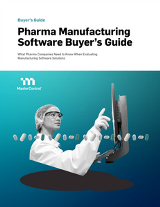
Ready to explore what lies in that critical middle ground? Download our Pharma Manufacturing Software Buyer's Guide to discover the solution category that's changing the game for pharma manufacturers.
Beyond Basic Digitization: The Evolution of Smart Manufacturing
Let's be clear: simply moving from paper to digital isn't enough anymore. While that's a necessary first step, the pharmaceutical industry is evolving rapidly, and your manufacturing systems need to keep pace.
Many pharma manufacturers already have islands of intelligence or automation scattered throughout their operations. The problem is that these systems often don't talk to each other effectively. Data sits in silos. Processes remain disconnected. The promise of true digital transformation remains just out of reach.
The future of pharmaceutical manufacturing lies in something more sophisticated, something that bridges the gap between basic documentation and comprehensive execution control. We're talking about a new era of connected, intelligent manufacturing that:
- Eliminates data silos across your operation.
- Provides real-time visibility without overwhelming complexity.
- Offers the agility to adapt to new products and modalities.
- Strengthens quality and compliance without slowing you down.
This is the journey toward Pharma 4.0—and it's not just theoretical. Forward-thinking manufacturers are already making this transition.
But here's the question: how do you evaluate whether a manufacturing solution can actually deliver on these promises?
What to Look for in a Modern Manufacturing Solution
When evaluating MES software and integrated manufacturing solutions for pharmaceutical production, most manufacturers don't have a clear framework for assessment. They end up comparing feature lists without understanding which capabilities truly matter for their specific needs.
The good news is that there's a better way to approach this decision.
A comprehensive evaluation framework should consider multiple critical factors that separate truly connected, intelligent systems from legacy solutions. While we can't reveal all the criteria here (you'll want to download the full buyer's guide for that), let's explore a couple of key considerations:
1. Production Visibility With Actionable Guidance
It's not enough to simply see what's happening on your shop floor. Modern pharmaceutical manufacturing demands real-time visibility into work-in-progress and operator execution, paired with guided actions that keep production moving smoothly.
As a manufacturing leader in your organization, you must ask yourself: Does the current system just show you data, or does it actually guide your operators toward the right actions at the right time?
2. Real-Time Process Exception Management
In pharmaceutical manufacturing, exceptions—deviations from standard procedures—can have serious consequences. The ability to identify process exceptions instantly from the shop floor can minimize disruptions, reduce scrap, and prevent costly production delays. The crux of the matter is how quickly your system can detect, communicate, and help resolve these exceptions.
These are just two of the critical factors you should be evaluating. Our buyer's guide reveals the complete evaluation framework, including additional criteria around data capture, analytics, training integration, collaboration capabilities, and more—all designed to help you make a confident, informed decision.
Get the full evaluation framework in our Pharma Manufacturing Software Buyer's Guide
Introducing the "Connected EBR" Concept
The pharmaceutical manufacturing software landscape is evolving, and a new solution category is emerging: the connected EBR.
Think of it as the solution that lives in that critical middle ground we discussed earlier. It's more robust than a traditional EBR that simply documents production activities, yet more flexible and accessible than a full MES.
But what makes an EBR "connected"? That's exactly the kind of insight that can transform how you think about your manufacturing technology stack, and it's one of the key topics covered in depth in the buyer's guide.
The connected EBR approach represents a fundamental shift in how pharmaceutical manufacturers think about production systems. It's about finding the right level of control and connectivity for your specific operations, rather than forcing your operations to conform to an oversized or undersized system.
The Path Forward: Making the Right Choice for Your Operation
The reality is this: pharmaceutical manufacturers are operating in an environment that is increasing in complexity. Products are becoming more personalized. Regulatory requirements are intensifying. Competition is fierce. And the margin for error continues to shrink.
Your manufacturing systems should be enablers of success, not sources of frustration.
Whether you're currently struggling with:
- Disconnected systems that create data silos,
- Manual processes that slow production and increase error risk,
- Lack of real-time visibility into operations,
- Difficulty adapting to new products or production changes, or
- Compliance concerns with your current documentation approach,
...there's a better way forward.
The key is understanding what questions to ask, what capabilities truly matter, and how to evaluate solutions that claim to solve these challenges. That's exactly what our comprehensive buyer's guide provides.
Inside the guide, you'll discover:
- The complete spectrum of manufacturing software options and where your needs truly lie.
- A detailed evaluation framework with all critical factors for selecting the right solution.
- Why traditional pharma MES may not be the right choice for your operation.
- How to assess whether a connected EBR approach aligns with your manufacturing needs.
- Real-world insights into how modern pharmaceutical manufacturers are solving these challenges.
Take the Next Step
The gap between basic EBRs and full-scale MES has left too many pharmaceutical manufacturers struggling with suboptimal, ill-fitting solutions for too long. But the landscape is changing, and new options are emerging that provide the right balance of capability, flexibility, and accessibility.
Understanding your options is the first step toward making a change that could transform your operations.
We've created this buyer's guide specifically to help manufacturers navigate the complexities of selecting an integrated manufacturing solution that not only meets current operational needs but also positions you for future growth and compliance across the production lifecycle.
Download the Pharma Manufacturing Software Buyer's Guide now and discover the evaluation framework that leading pharmaceutical manufacturers are using to make confident technology decisions.
Don't settle for systems that don't quite fit. Your manufacturing operation—and the customers and patients you serve—deserve better.
Ready to explore the full spectrum of pharmaceutical manufacturing software options and find the solution that's right for your operation? Access the complete Pharma Manufacturing Software Buyer's Guide here.

Manufacturing, Quality, and Asset Management — Simplified with Life Sciences-Specialized AI.
MasterControl Inc. is a leading provider of cloud-based quality and manufacturing software for life sciences and other regulated industries. For three decades, our mission has been the same as that of our customers – to bring life-changing products to more people sooner. MasterControl helps organizations digitize, automate, and connect quality and manufacturing processes. Innovative MasterControl tools have a proven track record of improving product quality, reducing cost, and accelerating time to market. Over 1,100 companies worldwide use MasterControl solutions to streamline operations, maintain compliance, easily analyze and interpret large amounts of data, and visualize business insights in real time.