
Why 69% of Pharma Companies Are Stuck Piloting AI (And How to Break Through)
Your quality systems are digital. Your manufacturing execution systems (MES) are live. You've invested millions in technology infrastructure over the past decade. So why are 69% of pharmaceutical manufacturers still stuck piloting artificial intelligence (AI) rather than deploying it at scale?
The answer isn't what most industry leaders expect. According to our new digital maturity report surveying over 130 pharmaceutical manufacturing professionals globally, the pharmaceutical industry is facing a "connectivity crisis"—and it's fundamentally different from a digitization problem. This research reveals critical insights about AI adoption barriers that go far deeper than technology tools or budgets, directly impacting your organization's digital maturity trajectory.
If you're spending nearly half your technology time converting legacy paper records and fighting persistent data quality issues, this research reveals why that work alone won't get you to AI readiness.
Take the free digital maturity assessment to discover where your organization falls on the digital maturity framework and what it takes to move forward.
The Problem Everyone's Experiencing (But Few Are Naming Correctly)
The pharmaceutical industry has made undeniable progress. Manual operations have virtually disappeared—declining from 9% in 2022 to just 1% in 2025, according to survey respondents. That's a significant achievement worth celebrating. Yet despite these gains in basic digitization, something is fundamentally blocking the path to AI-powered operations.
Consider these eye-opening statistics from our research:
100% of respondents say managing inspections and audits remains challenging and time-consuming.
98% can't predict quality issues before they occur because they lack proactive risk indicators and early warnings.
96% deal with rework and scrap associated with out-of-specification results, deviations, and corrective actions/preventive actions (CAPAs).
96% experience quarantine and delays in product release due to lengthy quality assurance (QA) reviews.
You've digitized. You've spent millions. Yet every audit still feels like archaeological excavation through disconnected systems, and quality issues continue surprising you instead of being prevented.
Here's the concerning thing the research revealed: While organizations achieving "Connected" status grew from 30% to 45% between 2022 and 2025, those reaching the "Intelligent" tier—representing true AI-driven operations—actually declined from 3% to 1%. This isn't just slow progress. It's movement in the wrong direction.
What industry insiders are now calling "infrastructure debt" represents the real barrier. Pharmaceutical manufacturers possess data lakes, cloud storage, and analytical tools, but they lack the clean master data definitions, standardized data models, governed data flows, and connected system architectures that enterprise AI demands.
The Real Culprit: The Connectivity Crisis
Here's where it gets interesting—and paradoxical.
Our research reveals that 59% of pharmaceutical leaders recognize integrated systems as the essential prerequisite for AI success. Yet nearly 50% identify data security issues and integration challenges as their biggest barriers preventing AI deployment.
Think about that for a moment. The industry knows what's needed but remains unable to achieve it.
This is the connectivity crisis: the gap between understanding the importance of integration and actually building connected ecosystems. It's the difference between being digital (you've replaced paper) and being connected (you're ready for AI). Most companies are stuck in between. And that gap is costing millions in delayed innovation, operational inefficiency, and competitive disadvantage.
Discover the four-tier digital maturity framework and learn which tier blocks most organizations from advancing to AI-powered manufacturing.
The pharmaceutical industry's wave of consolidation has exacerbated this crisis. While individual pharma manufacturers have invested heavily in core systems, decades of mergers, acquisitions, and site-specific implementations created a fragmented technology landscape that defies integration. You're not dealing with a single system problem—you're managing an ecosystem of disconnected platforms that were never designed to work together.
This fragmentation manifests in predictable ways:
Siloed data systems that require manual reconciliation across quality, manufacturing, and regulatory functions.
Redundant data entry that multiplies error risks and drains productivity.
Lack of real-time visibility across the enterprise, preventing proactive decision-making.
Inability to establish authoritative single sources of truth that AI systems require.
The path to AI readiness isn't about adding more technology on top of this fragmented foundation. It's about fundamentally re-engineering how systems connect and share data.
What This Means for Your AI Timeline
Most research respondents expect AI to significantly impact their operations within three to five years. But here's the uncomfortable truth our data uncovers: your timeline for AI deployment isn't determined by AI technology maturity. It's determined by your connectivity infrastructure—or the lack thereof.
The research identifies two distinct types of barriers blocking the adoption of AI:
Technical Barriers
Integration challenges between legacy systems and modern platforms.
Data quality and standardization issues.
Security concerns about AI model training on sensitive manufacturing data.
Validation requirements for AI-driven quality decisions (cited by 94% of respondents).
Cultural Barriers
Half of respondents cited cultural resistance as a significant obstacle.
Poor employee adoption and utilization of quality systems (94%).
Legacy thinking patterns that favor digitizing existing paper workflows rather than re-engineering processes to be data-first.
Organizational inertia against changing established procedures.
What's particularly revealing: 55% of organizations report having only partial implementation of digital systems, while 38% still have no implementation at all in certain areas. This means more than 90% of the industry lacks the complete, connected foundation necessary for enterprise AI.
Access the complete breakdown of technical and cultural barriers identified by 130-plus pharmaceutical manufacturing and quality leaders.
Beyond Digitization: Building for Intelligence
The research makes a critical distinction that every pharma leader needs to understand: digital maturity in manufacturing requires more than converting paper to pixels. True transformation demands a shift from siloed digital tools to unified, enterprise-wide platforms that:
Eliminate redundant data entry across business units.
Establish authoritative single sources of truth.
Enable seamless real-time data flow between previously disconnected systems.
Support AI-powered manufacturing with clean, structured, and harmonized data.
This isn't about working faster with your current approach. It's about working differently.
The organizations successfully advancing toward AI-driven manufacturing share common characteristics:
They start with the right foundation: A unified, connected platform from day one, not a collection of point solutions to integrate later.
They build incrementally toward intelligence: Moving from the Digital to the Connected tier before layering AI capabilities.
They avoid infrastructure debt: Cloud-native architecture designed for connectivity, not retrofitted integrations.
They establish end-to-end process integration: Fully integrated software applications working together as a true system of systems.
They update legacy thinking, not just legacy systems: Re-engineering processes to be data-first rather than simply digitizing existing paper workflows.
The question isn't whether your current systems can eventually support AI. The question is whether building that support on your current foundation will take longer and cost more than starting with a connected architecture designed for AI-powered operations from the beginning.
The Path Forward Exists—You Just Need to See It
Here's the good news buried in this alarming industry data: The connectivity crisis isn't insurmountable. Our research doesn't just diagnose the problem—it maps the actual path from where you are today to intelligent, AI-driven operations.
The framework is based on real implementations and industry benchmarks, not theoretical predictions. It accounts for both the technical requirements (integrated systems, quality data governance, and standardized models) and the organizational challenges (change management, staged adoption, and user-centric design) that pharmaceutical manufacturers actually face.
Download the full digital maturity report to access the complete framework, including specific strategies for addressing each pain point identified in the research.
Making Your Next Move
The pharmaceutical industry stands at a critical inflection point. Those who solve the connectivity crisis now will lead the next decade of innovation in AI-powered manufacturing. Those who continue layering technology on fragmented foundations will fall further behind—not because they lack ambition or resources, but because they're building on infrastructure that can't support their goals.
The data is clear: digital maturity for pharma isn't achieved through incremental digitization projects. It requires a fundamental shift in how you think about technology architecture, data governance, and system integration.
This research provides the roadmap. It reveals:
The four-tier digital maturity framework and where your organization likely falls.
The complete breakdown of pain points across quality and manufacturing operations.
Technical and cultural barriers identified by your industry peers who face the same challenges.
A proven methodology for moving from pilot projects to production-scale AI.
Specific strategies for building connected ecosystems that eliminate infrastructure debt.
The question is no longer whether AI will transform pharmaceutical manufacturing. The question is whether your organization has the connected foundation to participate in that transformation—or whether you'll spend the next five years building it while competitors who solved the connectivity crisis pull ahead.
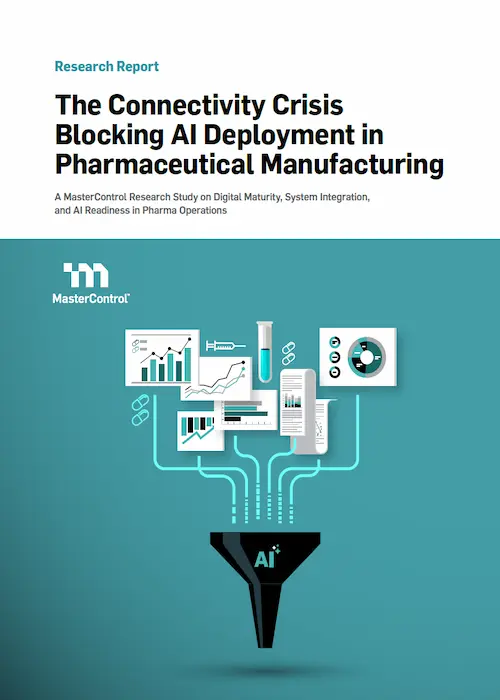
Access the full "Connectivity Crisis" research report here to understand exactly what separates organizations stuck in the Digital tier from those achieving true AI readiness—and what it takes to make that leap.

Manufacturing, Quality, and Asset Management — Simplified with Life Sciences-Specialized AI.
MasterControl Inc. is a leading provider of cloud-based quality and manufacturing software for life sciences and other regulated industries. For three decades, our mission has been the same as that of our customers – to bring life-changing products to more people sooner. MasterControl helps organizations digitize, automate, and connect quality and manufacturing processes. Innovative MasterControl tools have a proven track record of improving product quality, reducing cost, and accelerating time to market. Over 1,100 companies worldwide use MasterControl solutions to streamline operations, maintain compliance, easily analyze and interpret large amounts of data, and visualize business insights in real time.
Follow Us
Research Report
Enjoying this blog? Learn More.
The Connectivity Crisis Blocking AI Deployment in Pharmaceutical Manufacturing