
Beyond PCCPs: The Documentation Pharma Quality Teams Need for AI Compliance in 2025
Only 9% of life sciences professionals understand U.S. and EU artificial intelligence (AI) regulations well. Yet AI could add \$100 billion in value to our industry. That's not just a compliance gap—it's a massive missed opportunity.
Quality. Connected. Compliance. Simplified.
That changes everything.
As AI in life sciences transforms our industry, quality teams face new documentation challenges. Predetermined Change Control Plans (PCCPs) provide a starting point for AI-enabled medical devices, but they're just the beginning. With regulatory bodies like the U.S. Food and Drug Administration (FDA) now using AI tools such as Elsa to evaluate quality systems and target inspections, it's time to prepare for a new era of AI oversight—both as users and subjects of AI evaluation.
The Evolving Regulatory Landscape for AI in Life Sciences
Regulatory agencies are rapidly developing frameworks to govern AI in life sciences. The European Medicines Agency (EMA) and FDA AI initiatives are leading these efforts. While the FDA layers AI considerations onto existing drug laws and GxP frameworks, the EU moves ahead with specific regulations through the EU AI Act, Annex 11, and Annex 22.
These approaches share common principles:
Governance.
Data quality.
Transparency.
Validation proportional to risk.
Clear qualification requirements.
When AI influences quality decisions, it must be treated like any critical system—with documented intent, risk assessment, validation, oversight, and continuous monitoring to ensure life science compliance.
FDA AI Documentation Requirements
The FDA AI framework expects comprehensive documentation when AI touches submissions, clinical trials, or manufacturing:
1. For submissions impacted by AI: Define the context of use, document data provenance and quality, demonstrate bias control, verify and validate the model, monitor performance, and explain change control processes.
2. For clinical trials using AI: Treat AI like other electronic tools, i.e., validate systems, maintain audit trails, control access, and preserve data integrity.
3. For manufacturing processes incorporating AI: Clearly document when an AI model is part of an approved process and establish when model changes constitute reportable changes to maintain AI compliance.
EU AI Act: A Structured Framework for Life Science Compliance
The European Union provides more structured guidance through several key documents, with the EU AI Act at its center:
EU AI Act Requirements for Life Science Compliance
High-risk AI systems must meet specific requirements, including:
AI-specific risk management.
Data and data governance controls.
Technical documentation.
Logging and recordkeeping of AI usage.
Transparency in deployment.
Human oversight documentation.
Cybersecurity measures.
These requirements must be supported by documentation maintained through a quality management system (QMS), and systems must carry markings showing they meet these requirements—a core expectation for AI compliance in life sciences.
In an environment where rapidly evolving regulations create uncertainty, many organizations adopt a "wait and see" approach. This hesitation means missed opportunities. Instead of waiting, the smart move is to partner with trusted organizations that have deep expertise in both AI and regulatory compliance to accelerate adoption safely.
Get the 5 Critical Requirements for AI Compliance in Life Sciences
Essential Documentation for AI Compliance in Life Sciences in 2025
To meet evolving requirements across jurisdictions, you need several categories of documentation for AI compliance:
1. Data Integrity and Electronic Records
Data integrity forms the foundation of product quality and patient safety. When implementing AI tools, ensure compliance with 21 CFR Part 11 for electronic records and signatures, while adhering to EU GMP Annex 11 for computerized systems.
Successful implementation requires:
System access controls with unique user identification.
Comprehensive audit trails capturing who made changes, when, and why.
Risk-based approaches focusing resources on critical data that impacts product quality and patient safety.
Regular system audits coupled with automated verification processes.
2. Assessing Fit for Use
Evaluate AI tools for their fit with your business and unique use cases. This requires verification of functionality and assurance that the foundational platform architecture is validated and compliant.
Leading organizations apply FDA guidance on Computer Software Assurance (CSA) and AI/ML-Based Software, combined with GAMP 5 Second Edition principles, as a framework for ensuring AI systems are fit for their intended use while maintaining compliance.
3. Transparency and Explainability
Recent FDA communication on AI usage emphasizes the importance of "explainable AI," requiring clear understanding and traceability of AI-driven decisions that impact product quality and patient safety.1
Your documentation must demonstrate:
Clear explanations of AI decision-making and recommendation processes.
"Human in the loop" oversight of AI systems.
Review processes for data and content accuracy.
Interpretation protocols for AI-generated insights or content.
4. Risk Management
Risk management for AI systems must align with ICH Q9 principles while addressing unique challenges posed by artificial intelligence. The dynamic nature of AI systems requires a more sophisticated approach that considers both traditional quality risks and AI-specific concerns like algorithm bias, hallucinations, and data quality dependencies.
Successful programs include:
Comprehensive risk assessments evaluating potential impacts across the entire product lifecycle.
Documentation of systematic risk evaluation for each AI implementation.
Regular risk reviews assessing both AI system performance and control measure effectiveness.
Clear procedures for system failures, including defined thresholds for reverting to manual processes.
Learn all 5 Critical Requirements for Ensuring AI Compliance in Life Sciences
5. Data Privacy and Security
In modern connected manufacturing environments, data privacy and security for AI systems must comply with both industry-specific regulations (like 21 CFR Part 11) and broader data protection requirements like the EU's General Data Protection Regulation (GDPR).
Leading organizations implement multiple layers of protection, including:
Robust encryption for data at rest and in transit.
Granular access controls.
Comprehensive audit trails of data access and usage.
Strict controls on data routing and storage.
Going Beyond PCCPs: Comprehensive AI Compliance Strategy for Life Sciences
While PCCPs provide an important framework for AI-enabled medical devices, you need a more comprehensive approach to AI compliance documentation. Key strategic considerations include:
Data Quality as the Foundation for FDA AI and EU AI Act Compliance
Clean, structured, and timely data isn't just important for AI performance—it's essential for regulatory compliance. Document data cleaning procedures, governance protocols, and integrity safeguards to demonstrate that AI systems operate on reliable information.
Risk-Based Documentation Approach
Not all AI in life sciences applications carry the same risk. Develop a tiered documentation strategy where higher-risk AI applications (those affecting critical quality attributes, patient safety decisions, or regulatory submissions) receive more extensive documentation than lower-risk applications like document translation or training exam generation.
Closed-Loop Documentation Systems
Establish documentation processes that connect AI implementations to their outcomes. When AI suggests process improvements or identifies quality issues, document how these insights translate to actions, validations, and ultimately, quality improvements to demonstrate life science compliance.
Evidence of Human Oversight for FDA AI and EU AI Act Requirements
Maintain clear documentation of how humans remain "in the loop" for AI-driven decisions. This includes:
Review protocols for AI-generated content.
Approval workflows for AI recommendations.
Override logs when human judgment supersedes AI suggestions.
Rationale documentation for disagreements with AI outputs.
How QMS Solutions Support AI Compliance Documentation in Life Sciences
Modern quality management systems help you leverage AI in life sciences while maintaining regulatory compliance. Key features supporting AI documentation requirements include:
Secure AI Architecture for Life Science Compliance
Advanced QMS solutions incorporate AI capabilities built specifically for the life sciences industry, with robust governance controls maintaining transparency and data security. Leading providers ensure data remains within secure cloud privacy boundaries without transmission to third parties—addressing key concerns in FDA AI and EU AI Act regulations.
Document Management for AI Governance
Effective QMS solutions provide structured repositories for AI governance documentation, including version control, approval workflows, and training management. These systems maintain the specialized documentation required for AI applications, ensuring you're always inspection-ready.
Preparing for AI-Enhanced Regulatory Oversight
As regulatory bodies implement AI tools like the FDA AI system Elsa, quality teams must prepare for more data-driven, targeted inspections. Documentation systems must evolve from simply storing records to making them readily analyzable by both human inspectors and AI tools.
Regulatory AI tools will increasingly scan for patterns indicating potential compliance issues—inconsistent documentation, unusual deviations, or outlier quality results. By maintaining comprehensive documentation of AI implementation and governance, you demonstrate your commitment to patient safety and life science compliance.
Conclusion
As you navigate AI in life sciences implementation in 2025 and beyond, documentation requirements will continue to evolve. PCCPs represent just one element of a comprehensive strategy needed to demonstrate AI compliance.
By establishing robust documentation practices covering governance, technical implementation, validation, change control, training, and monitoring, you can confidently implement AI solutions that enhance quality while maintaining compliance with FDA AI requirements and the EU AI Act.
The AI imperative for life sciences can't be ignored. With proper implementation, you can save hundreds of hours and thousands of dollars with tools that will help you augment, or even rethink, your processes. The rigorous evaluation required before implementation might delay these benefits. Partner with vendors who have expertise in both AI development and regulatory compliance to experience these efficiencies faster.
Download the Complete Industry Brief on Ensuring AI Compliance in Life Sciences
The future of quality management isn't about choosing between human expertise and artificial intelligence. It's about documenting how the two work together—with AI handling low-risk, repetitive tasks while empowering your quality professionals to focus on strategic initiatives that improve patient outcomes, all within the framework of rigorous life science compliance.
References:
"Explainable AI and Regulation in Medical Devices," Cambridge Consultants, FDA website, accessed Oct. 1, 2025.

Manufacturing, Quality, and Asset Management — Simplified with Life Sciences-Specialized AI.
MasterControl Inc. is a leading provider of cloud-based quality and manufacturing software for life sciences and other regulated industries. For three decades, our mission has been the same as that of our customers – to bring life-changing products to more people sooner. MasterControl helps organizations digitize, automate, and connect quality and manufacturing processes. Innovative MasterControl tools have a proven track record of improving product quality, reducing cost, and accelerating time to market. Over 1,100 companies worldwide use MasterControl solutions to streamline operations, maintain compliance, easily analyze and interpret large amounts of data, and visualize business insights in real time.
Follow Us
Industry Brief
Enjoying this blog? Learn More.
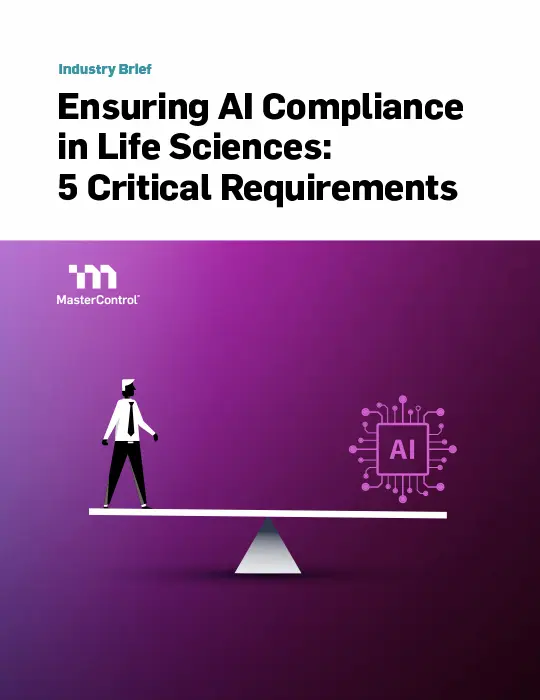
Ensuring AI Compliance in Life Sciences: 5 Critical Requirements