
FDA Issues First Warning Letter for AI Compliance Failures – What Life Sciences Companies Must Know
In a landmark development that will reshape how life sciences companies approach artificial intelligence (AI), the U.S. Food and Drug Administration (FDA) has issued its first-ever warning letter explicitly citing AI misuse as a compliance violation. On April 2, 2026, the agency sent a warning letter to Purolea Cosmetics Lab, marking a historic turning point in regulatory oversight of AI usage in pharmaceutical manufacturing.
This isn't just another FDA warning letter—it's a clear signal that regulatory agencies are now actively scrutinizing how companies implement AI tools in quality and compliance operations. For quality, regulatory, and compliance professionals across the life sciences industry, the message is unmistakable: AI can be a powerful enabler of efficiency and innovation, but only when implemented with proper guardrails, governance, and human oversight.
What happened at Purolea Cosmetics Lab, and what does it mean for your organization? Let's break down the critical lessons from this AI-related warning letter and explore how you can harness AI's benefits while maintaining regulatory compliance.
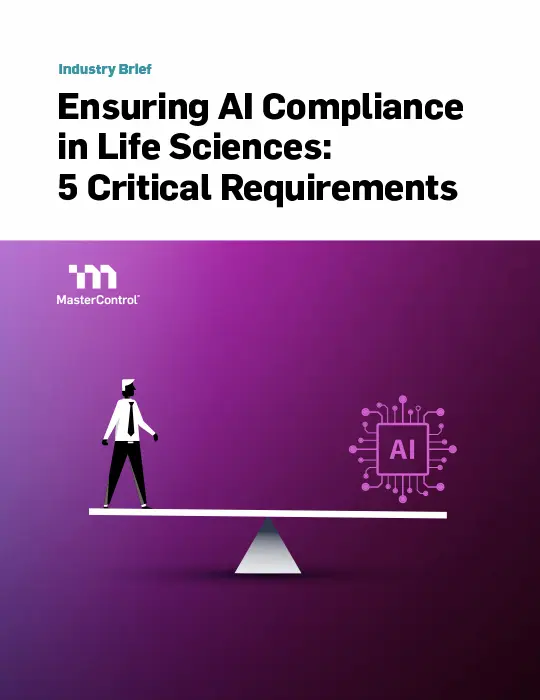
Want to dive deeper into AI compliance requirements? Download our comprehensive industry brief: Ensuring AI Compliance in Life Sciences: 5 Critical Requirements to get expert guidance on implementing AI safely and compliantly in your operations.
What Happened: The FDA's First AI Warning Letter
The warning letter to Purolea Cosmetics Lab revealed multiple violations of current good manufacturing processes (cGMP), but one section stood out as unprecedented. The company had deployed AI agents to create critical quality documents, including:
Drug product specifications.
Standard operating procedures.
Master production and control records.
While using AI for document creation isn't inherently problematic, Purolea's fatal flaw was what came next—or rather, what didn't come next. The company failed to implement human review or validation of these AI-generated documents.
The most striking detail from the warning letter illustrates the danger of over-reliance on AI tools. When FDA investigators informed the company that they hadn't conducted required process validation before distributing drug products, company representatives responded that they weren't aware of this legal requirement because, as they stated, "the AI agent never told them it was required."
Let that sink in. A pharmaceutical manufacturer was making critical compliance decisions based solely on the output of an AI tool, without qualified human oversight to verify accuracy or completeness.
The FDA's Explicit Response
The agency's directive was unequivocal:
"If you use AI as an aid in document creation, you must review the AI generated documents to ensure they were accurate and actually compliant with cGMP. Your failure to do so is a violation of 21 CFR 211.22(c)."
The FDA further specified that "any output or recommendations from an AI agent must be reviewed and cleared by an authorized human representative of your firm's QU [Quality Unit]."
This wasn't an isolated violation. The AI misuse occurred alongside broader quality system failures, including insanitary conditions, inadequate laboratory testing, and quality unit oversight deficiencies. However, the explicit citation of inappropriate AI usage marks the first time the FDA has formally addressed this issue in a warning letter, establishing a regulatory precedent that will influence how agencies worldwide approach AI oversight.
The Core Problem: When AI Operates Without Oversight
Why did Purolea's approach fail so dramatically? The answer reveals fundamental limitations of AI technology in regulated environments:
AI Tools Lack Critical Context: Although it's unclear whether Purolea used specialized or general-purpose AI tools, it is a fact that general-purpose AI systems don't understand a life sciences organization's company-specific processes, risk assessments, or regulatory history. They can't account for the unique aspects of your operations that inform compliance decisions.
The Hallucination Risk: AI models can generate plausible-sounding but factually incorrect information with complete confidence. In regulatory documentation, these "hallucinations" can lead to serious compliance gaps when not caught and rectified by knowledgeable human professionals. Although hallucinations are a risk with all AI models, some applications do more to prevent them than others.
No Accountability Chain: When AI generates a document, there's no qualified person taking responsibility for its accuracy. Organizations in the life sciences face a complex challenge of balancing innovation with regulatory compliance, and AI without human oversight breaks the accountability structure that cGMP regulations require.
The Human Oversight Gap: Technology, no matter how advanced, can't replace qualified personnel in making compliance judgments. Regulatory compliance requires professional expertise, contextual understanding, and accountability—qualities that AI simply cannot provide on its own. This underscores the importance of intentional human-in-the-loop checkpoints in AI-powered systems prior to implementation.
The Purolea case demonstrates what happens when companies treat AI as a replacement for human expertise rather than a tool to enhance it. While AI can help streamline processes and improve efficiency, the ultimate responsibility for compliance decisions must rest with qualified professionals who need to understand both the technology's capabilities and its limitations.
Ready to implement AI the right way? Our industry brief breaks down the essential framework for maintaining compliance while leveraging AI's benefits. Download it now to learn the critical requirements you need to address.
What This Means for Your Organization
This warning letter has immediate and far-reaching implications for life sciences companies at every stage of AI adoption:
Regulatory Expectations Are Now Explicit
Human oversight is no longer optional—it's mandatory. The FDA has drawn a clear line: AI can assist, but humans must verify, review, approve, and have responsibility for all outputs, including compliance-critical outputs.
The Risk Extends Beyond Documentation
While Purolea's violations centered on procedure creation, the implications touch every aspect where AI might be deployed:
Quality control decision-making.
Batch record review.
Deviation investigations.
Regulatory submission preparation.
Risk assessments.
In each case, patient safety and product quality hang in the balance. The evolving regulations and guidance globally mean that what's acceptable today may not meet tomorrow's standards.
A Precedent for Global Regulators
When the FDA acts, regulatory bodies worldwide take notice. Expect similar scrutiny from:
European Medicines Agency (EMA).
UK's Medicines and Healthcare products Regulatory Agency (MHRA).
Health Canada.
Therapeutic Goods Administration (TGA) in Australia.
This warning letter signals the beginning of a new era in regulatory oversight of AI usage across global markets.
An Opportunity for Proactive Leadership
Rather than viewing this as a barrier to innovation, forward-thinking organizations will see it as an opportunity to establish best practices and demonstrate regulatory maturity. Companies that get AI implementation right—combining technology's efficiency, implementation that trains people appropriately, effective governance, and processes that still rely on human expertise and decision-making—will gain competitive advantages in speed, quality, and regulatory confidence.
Building Compliant AI Implementation: Essential Safeguards
So how do you harness AI's benefits while maintaining compliance? Here are the essential safeguards you need:
1. Human-in-the-Loop Approach
The foundation of compliant AI usage is robust human oversight:
Establish strong governance principles and standardized policies around safe usage.
Establish standardized processes for which qualified personnel must review and verify all AI-generated outputs before they're used in compliance-critical decisions.
Establish clear approval chains with documented accountability for AI-assisted processes.
Define roles and responsibilities for who reviews what types of AI outputs.
Ensure reviewers have the expertise to evaluate both the content and the appropriateness of the AI tool's application.
2. Validation and Verification Protocols
Treat AI tools like any other system in your quality environment:
Test AI outputs against established standards before deployment.
Train employees on the AI and create SOPs before deploying in production.
Document your validation approach, including how you assess accuracy, reliability, and suitability for intended use.
Implement continuous monitoring to catch drift or degradation in AI performance.
Establish guardrails for when AI outputs require additional scrutiny or shouldn't be used at all.
Simplify the validation of content by requiring citations in generated content.
Although industry standards for how a non-deterministic system should be validated have yet to be developed, organizations should still seek to align with industry best practices such as those being worked on by groups like BioPhorum.
3. Risk-Based Implementation
The dynamic nature of AI systems requires sophisticated risk management:
Conduct comprehensive risk assessments across the entire product lifecycle.
Consider AI-specific risks such as bias, data quality dependencies, and model limitations.
Maintain evidence of systematic risk evaluation for each AI implementation.
Establish data governance committees or councils to oversee AI data management practices.
4. ISO 42001 Compliance
Look for AI tools that are ISO 42001-compliant. This international standard provides a framework for AI management systems, ensuring responsible development and use of AI. MasterControl's AI solutions, for example, are built with ISO 42001 compliance in mind, providing an architectural foundation of assurance for quality-critical applications.
MasterControl adheres to the following ISO 42001 Governance Framework:
Internal Committee: Continuous oversight and collaboration across departments: Compliance, Legal, Security, AI/ML team.
Lifecycle Governance: Every phase of AI development, from inception, to development, deployment, and monitoring is governed by documented security controls and rigorous testing.
Risk Management: AI-specific controls, threat modeling and mitigation strategies to prevent data breaches, algorithm bias, legal, or ethical concerns.
Explainability Requirements: Mandatory documentation throughout the AI lifecycle, including model cards, audit logs, and records of decision-making processes.
Performance Monitoring: Ongoing tracking and proactive monitoring of accuracy of results, drift, and anomalies.
5. Quality System Integration
AI tools must work within your existing quality framework:
Safely integrate artificial intelligence into your quality management system (QMS).
Ensure the quality unit has oversight of AI applications per cGMP regulations.
Establish security that ensures your data is handled within a trusted cloud privacy boundary and not passed outside of the system, creating a "black box."
Maintain comprehensive audit trails of data access, AI usage, and human review decisions.
Document AI tool selection, validation, and deployment in accordance with your quality procedures.
Want detailed implementation guidance and industry best practices? Our AI compliance industry brief provides step-by-step frameworks from regulatory experts who understand both AI technology and cGMP requirements.
The Solution: Purpose-Built AI for Life Sciences
Here's the reality: not all AI tools are created equal. There's a critical distinction between general-purpose AI models and solutions specifically designed for regulated life sciences environments.
When evaluating AI tools for compliance-critical applications, look for these key differentiators:
Built-in Compliance Features
Specialized regulatory AI solutions include safeguards by design:
Transparency through citations and source verification so users can verify the basis for AI-generated information.
Cross-referencing capabilities that reduce global compliance risk by connecting requirements across multiple regulatory frameworks.
Audit trails and traceability built into the tool's architecture.
Designed Specifically for Regulated Environments
Consider solutions like MasterControl's Regulatory Chat, which exemplifies compliant-by-design AI. Unlike general-purpose AI tools, Regulatory Chat provides instant access to regulatory information with built-in safeguards that help ensure accuracy and compliance. It's designed to be a tool that enhances human expertise rather than attempting to replace it. Learn more about Regulatory Chat's capabilities.
The right AI solution should make compliance easier, not create new risks. It should provide transparency, enable verification, and integrate seamlessly with your existing quality systems—all while keeping qualified humans firmly in the decision-making loop.
Conclusion: Moving Forward Responsibly
The FDA's first AI warning letter shouldn't give you a reason to avoid AI. But it should provide a wake-up call to implement it responsibly. As regulations continue to evolve and regulatory bodies worldwide watch how companies navigate this new terrain, now is the time to get ahead of requirements rather than scramble to catch up after receiving your own warning letter.
The key takeaway is clear: AI's future in regulatory compliance is bright, but only when balanced with proper human oversight, verified processes, and specialized tools designed for regulated environments.
Your next steps should include:
Auditing your current AI usage to identify any gaps in human oversight or verification.
Establishing clear policies for how AI tools can and cannot be used in quality-critical applications.
Investing in training so your team understands both AI's capabilities and its limitations.
Choosing AI solutions built for compliance, not general-purpose tools adapted to regulatory needs.
Ready to implement AI with confidence? Download our comprehensive guide: Ensuring AI Compliance in Life Sciences: 5 Critical Requirements. Plus, discover how MasterControl Regulatory Chat provides a proven, compliant solution for regulatory information access.
Sources
FDA Warning Letter to Purolea Cosmetics Lab, FDA website, content current as of April 14, 2026.

Manufacturing, Quality, and Asset Management — Simplified with Life Sciences-Specialized AI.
MasterControl Inc. is a leading provider of cloud-based quality and manufacturing software for life sciences and other regulated industries. For three decades, our mission has been the same as that of our customers – to bring life-changing products to more people sooner. MasterControl helps organizations digitize, automate, and connect quality and manufacturing processes. Innovative MasterControl tools have a proven track record of improving product quality, reducing cost, and accelerating time to market. Over 1,100 companies worldwide use MasterControl solutions to streamline operations, maintain compliance, easily analyze and interpret large amounts of data, and visualize business insights in real time.
Follow Us
Industry Brief
Enjoying this blog? Learn More.
Ensuring AI Compliance in Life Sciences: 5 Critical Requirements