
Why Your CGT Batch Is Ready Before Your QA Team Is (And 3 Other Bottlenecks You Can't Ignore)
Your manufacturing team just completed a five-day cell culture batch. The process went flawlessly. The product looks perfect. And now? It sits. Waiting. For a week or more.
If this scenario sounds familiar, you're far from alone. Cell and gene therapy (CGT) manufacturing represents one of health care's most promising frontiers, but operational bottlenecks are standing between patients and the life-saving therapies they desperately need. While the CGT industry continues to innovate at the scientific level, many manufacturers are discovering that their biggest challenges aren't happening in the lab—they're happening in the gaps between processes, across sites, and within their quality systems.
The reality? The four critical pressure points outlined below are silently extending vein-to-vein timelines across the CGT manufacturing landscape. But here's the good news: emerging solutions are helping forward-thinking manufacturers break through these barriers.
1. The Time Trap: When Quality Processes Become Quality Roadblocks
Let's start with the most visible bottleneck: quality assurance (QA), quality control (QC), and logistics represent the most time-sensitive pressure point in any cell or gene therapy manufacturing timeline. Your product might be ready, but the pathway to release? That's a different story.
Consider what's happening behind the scenes:
Manual batch record reviews that turn a straightforward approval into a multi-day (or multi-week) process.
Physical sample handling that introduces both delays and contamination risk as samples move between facilities.
Chain-of-identity handoffs where each transfer point becomes a potential failure point.
The irony isn't lost on manufacturers: the very processes designed to ensure quality are often the ones preventing timely delivery to patients. Every day a batch sits in limbo is another day a patient waits.
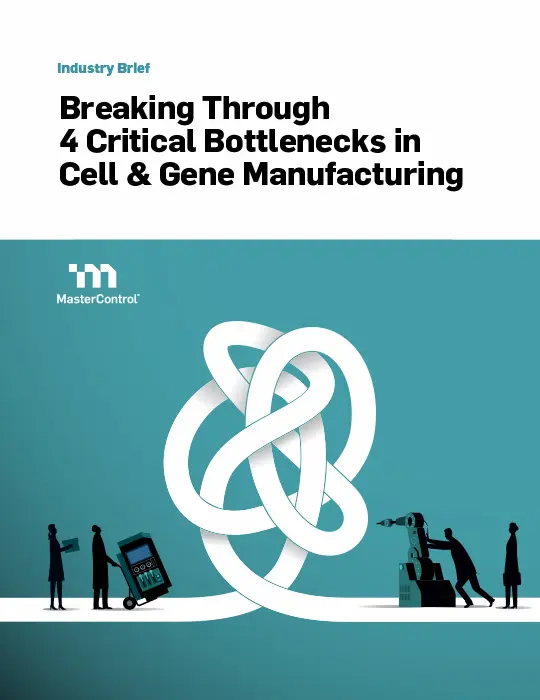
Want to understand how leading CGT manufacturers are streamlining their QA/QC processes? Download our comprehensive industry brief, "Breaking Through 4 Critical Bottlenecks in Cell & Gene Manufacturing," for detailed strategies.
But this is just the first bottleneck. The challenges only multiply as you scale.
2. The Consistency Conundrum: Why Every Site Feels Like Starting From Scratch
You've perfected your process at your Boston facility. Everything runs smoothly. Then you open a London site, and suddenly, it's like you're starting over. Sound familiar?
Site-to-site variability isn't just frustrating—it's expensive and risky. Equipment differences, material variations, operator interpretations, and divergent standard operating procedures (SOPs) create a web of inconsistency that regulators are increasingly scrutinizing. The U.S. Food and Drug Administration (FDA), European Medicines Agency (EMA), and Medicines and Healthcare products Regulatory Agency (MHRA) aren't just asking for comparable results anymore; they're demanding evidence of truly standardized processes.
The challenges this poses to CGT manufacturing are particularly acute:
Poorly coordinated tech transfer leads to delays, rework, and sometimes complete restarts.
Inconsistent data capture practices make it nearly impossible to provide the comparability evidence regulators demand.
Process drift between sites that compounds over time.
When your London site can't reliably replicate what works in Boston, you're not just facing operational delays—you're facing regulatory questions that could impact your entire program.
3. The Knowledge Crisis: Your Most Experienced Operators Are Walking Out the Door
Here's a scenario that should keep every CGT manufacturing leader up at night: Your most experienced operator—the one who knows exactly how to troubleshoot that finicky incubator, who can spot contamination risks before they become problems, who trained half your current team—is retiring next month.
The CGT industry is facing a dual workforce challenge that's unlike anything in traditional pharma manufacturing:
The "silver tsunami": A wave of experienced workers reaching retirement age, taking decades of institutional knowledge with them.
High turnover among younger operators: Less experienced staff cycling through positions before they've fully mastered complex processes.
Why does this matter more in CGT manufacturing? Because your processes are operator-dependent and inherently more prone to variability. In traditional manufacturing, a experienced operator might shave minutes off a cycle time. In CGT manufacturing, they might be the difference between a viable batch and starting over from scratch.
Discover how digital workflows can help preserve and standardize institutional knowledge—read our full analysis in "Breaking Through 4 Critical Bottlenecks in Cell & Gene Manufacturing."
What happens when institutional knowledge lives in people's heads instead of your systems? You're about to find out—and it's not likely to be pleasant.
4. The Silent Killer: Equipment Drift in a Batch-of-One World
Let's talk about the bottleneck that often goes unnoticed until it's too late: equipment drift. In traditional manufacturing, you might have multiple lots to buffer against equipment failures. In CGT? You're operating in a batch-of-one paradigm where a single equipment failure renders patient-specific product unusable.
Picture this scenario: It's 2 a.m. and your batch has been in the incubator for 72 hours. Everything looks perfect. Then, a temperature excursion. Maybe it's only a few degrees. Maybe it only lasts an hour. But the damage is done. Days of work invalidated. A patient forced back to the beginning of the process.
The challenge with equipment drift is that it's often invisible until the damage is done:
Gradual performance degradation that falls within acceptable ranges—until suddenly it doesn't.
Calibration schedules that depend on manual tracking and human memory.
Overnight shifts where monitoring may be less rigorous.
In a manufacturing paradigm where every batch counts—literally—equipment reliability isn't just about efficiency. It's about whether you can deliver therapy to the patient who's counting on you.
Learn about connected monitoring approaches that catch equipment drift before it impacts patient batches—download "Breaking Through 4 Critical Bottlenecks in Cell & Gene Manufacturing."
The Path Forward: From Bottlenecks to Breakthroughs
Here's what's encouraging: these bottlenecks aren't insurmountable. Digital manufacturing solutions are emerging that address each of these pressure points systematically.
Leading manufacturers are implementing:
Real-time visibility systems that eliminate the waiting game between manufacturing and quality release.
Standardized digital workflows that ensure consistency regardless of site, shift, or operator.
Connected equipment monitoring that catches performance issues before they impact batch quality.
Integrated platforms that break down silos between manufacturing, quality, and logistics.
These aren't theoretical solutions being tested in pilot programs. They're being implemented now by manufacturers who've decided that patient timelines can't wait for incremental improvements.
The difference? These solutions address the interconnected nature of CGT manufacturing challenges. Solving QA delays won't help if your equipment drifts out of spec. Standardizing processes across sites doesn't matter if your experienced operators leave and take all the troubleshooting knowledge with them.
The Bottom Line: Every Day Matters
In CGT manufacturing, every day of delay carries weight. Behind every batch sitting in a queue is a patient whose treatment timeline just got longer. Behind every equipment failure is a family wondering when therapy will be available. Behind every tech transfer delay is a missed opportunity to scale life-saving treatments.
The four bottlenecks we've explored—QA/QC delays, site variability, workforce knowledge gaps, and equipment drift—aren't isolated challenges. They're interconnected pressure points that compound each other. Solving one without addressing the others won't fundamentally change your vein-to-vein timeline.
But manufacturers who approach these challenges systematically, with integrated solutions that address the full spectrum of operational risk, are seeing real results. They're reducing wait times, improving consistency, preserving institutional knowledge, and catching equipment issues before they impact patients.
Ready to Break Through?
The strategies exist. The technology is available. The question is: how long will your patients wait while you figure out which bottleneck to tackle first?
Download our comprehensive industry brief, "Breaking Through 4 Critical Bottlenecks in Cell & Gene Manufacturing," to explore:
Detailed breakdowns of each bottleneck and their interconnected impacts.
Digital transformation approaches that leading CGT manufacturers are implementing today.
Implementation strategies for integrated manufacturing systems that address multiple pressure points simultaneously.
Real-world examples of how manufacturers are accelerating vein-to-vein timelines and improving patient outcomes.
The path forward is clearer than you think. Your next step? Understanding exactly how to navigate it.

Manufacturing, Quality, and Asset Management — Simplified with Life Sciences-Specialized AI.
MasterControl Inc. is a leading provider of cloud-based quality and manufacturing software for life sciences and other regulated industries. For three decades, our mission has been the same as that of our customers – to bring life-changing products to more people sooner. MasterControl helps organizations digitize, automate, and connect quality and manufacturing processes. Innovative MasterControl tools have a proven track record of improving product quality, reducing cost, and accelerating time to market. Over 1,100 companies worldwide use MasterControl solutions to streamline operations, maintain compliance, easily analyze and interpret large amounts of data, and visualize business insights in real time.
Follow Us
Industry Brief
Enjoying this blog? Learn More.
Breaking Through 4 Critical Bottlenecks in Cell & Gene Manufacturing