
Is a Salesforce-Based QMS Really Built for AI Governance in Life Sciences?
A narrative has been making the rounds in life sciences technology circles lately: Salesforce-based quality management systems are the modern, forward-thinking alternative to so-called "legacy" QMS platforms. The pitch usually hits the same notes: cloud-native architecture, automatic updates, a slick user interface, and now, thanks to Salesforce's Q4 2025 ISO 42001 certification covering its artificial intelligence (AI) products, a certified platform to anchor the whole story.
It sounds compelling. But if you're a decision-maker at a life sciences manufacturer, the more important question isn't about any single certification — it's about the platform your quality system is fundamentally built on. In an industry where compliance isn't a feature layer but the actual foundation of your operations, the difference between a QMS engineered from the ground up for regulated life sciences workflows and one that runs on top of a general-purpose CRM shows up everywhere: in how validation works, how documents are managed, how integrations scale, and yes, how AI governance is actually implemented. It's worth understanding exactly what those differences mean before you commit.
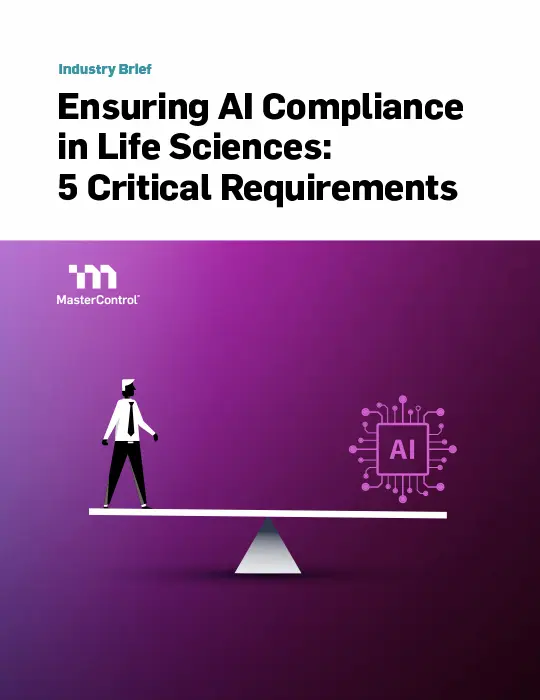
Start with the right framework. Download our free industry brief: Ensuring AI Compliance in Life Sciences: 5 Critical Requirements — created by MasterControl's regulatory and AI experts to help you implement AI confidently in a GxP environment.
ISO 42001 Certified — But Inherited, Not Engineered
In Q4 2025, Salesforce announced ISO 42001 certification for its AI products — Agentforce, Einstein AI, and Slack AI. For Salesforce as a technology company, that's a meaningful accomplishment. And yes, QMS vendors who build on the force.com platform can point to that certification and say the underlying infrastructure carries it.
But here's the crucial distinction: inheriting platform-level AI certification from a CRM is not the same as engineering AI governance into the architecture of a purpose-built, regulated quality platform.
This matters because every Salesforce-based QMS — regardless of how it's branded or marketed — is drawing from the same platform well. Any AI capabilities those products promote are a direct result of what Salesforce enables at the platform level, which means differentiation between Salesforce-based competitors on AI features is, at best, superficial. They are all working with the same toolkit, constrained by the same platform decisions, and dependent on the same third-party roadmap.
MasterControl takes a fundamentally different approach. Our AI capabilities are engineered into the foundation of a regulated AI platform designed specifically for life sciences quality and manufacturing, not layered onto a general-purpose CRM. That distinction matters when it counts most. When regulators ask how your AI tools affect data integrity, audit trails, or validation status, you need to be able to point to something more than a platform-level certification. With MasterControl, you can. Our comprehensive technical guardrails, strict data governance protocols, and transparent privacy practices not only comply with global regulations, they're designed to give your teams complete confidence in how critical data is protected, used, and managed. The result is an AI-compliant environment where innovation and regulatory rigor aren't in tension because they're built to work together.
A Sales Platform Isn't a Quality Platform
This brings us to a foundational question every life science manufacturer should be asking: what was your QMS platform actually built to do?
Salesforce is, at its core, a sales and marketing automation platform. It's exceptional at what it was designed for. But life sciences quality and manufacturing operate under some of the world's most demanding regulatory frameworks, including:
21 CFR Part 11: Electronic records and electronic signatures.
21 CFR Parts 210–211 — Current Good Manufacturing Practice (CGMP) for pharmaceuticals.
Quality Management System Regulation (QMSR): The updated regulation replacing 21 CFR Part 820, the quality system regulation for medical devices.
ISO 13485 — Quality management systems for medical devices.
The specific needs of quality and manufacturing teams in life sciences environments are simply not Salesforce's target market — and that shows in the platform's priorities. Any Salesforce-based QMS application is constrained by what the platform chooses to enable, prioritize, and support. MasterControl designs our products specifically to meet these regulatory requirements, not as configurations or workarounds, but as the architectural foundation of everything we build.
Wondering what truly AI-compliant quality management looks like in a regulated environment? Our free industry brief has the answers. Download it now.
The "Out-of-the-Box Validation" Claim Deserves Scrutiny
One of the most persistent talking points from Salesforce-based QMS vendors is the promise of seamless, out-of-the-box validation. It's an appealing claim because who wouldn't want a validated system ready at deployment?
Here's the reality: the U.S. Food and Drug Administration (FDA) requires software validation based on intended usage for each individual organization and does not endorse "out-of-the-box" validation as an acceptable approach. Validation must reflect how your company uses the system, in your regulated environment, for your specific processes. A one-size-fits-all validation package doesn't satisfy that requirement — and organizations that assume it does have found themselves stalled mid-implementation when validation becomes a genuine obstacle.
There's also a configurability concern worth flagging. Some Salesforce-based QMS vendors promote rapid deployment — up and running in days with minimal setup — but that kind of out-of-the-box simplicity often comes at the cost of configurability. As your organization grows and your quality processes evolve, a system that can't flex with you becomes a constraint rather than an asset.
Document Storage: A Cost That Compounds Over Time
Here's another issue that surfaces quickly once a Salesforce customer starts evaluating a force.com-based QMS in earnest: file storage costs.
Salesforce's storage model is transactional. The more content you store, the more you pay. For companies in the life sciences— where document management is central to everything from standard operating procedures (SOPs) and batch records to corrective action/preventive action (CAPA) records and validation packages — storage isn't a peripheral consideration. It's core infrastructure.
MasterControl includes 1 TB of storage in our standard subscription. No escalating fees as your document library grows. No surprises at renewal. Before selecting any force.com-based QMS, get direct answers to these questions:
What storage is included in the base subscription?
What does overage cost, and how is it calculated?
How does total storage cost scale over a 3–5-year document volume growth trajectory?
For organizations where high-volume, cost-predictable document management is non-negotiable, the answers to those questions deserve significant weight.
Building a compliant AI strategy for your quality operations? Download Ensuring AI Compliance in Life Sciences: 5 Critical Requirements — a free guide with practical frameworks you can apply immediately.
API Limits: The Integration Ceiling Nobody Advertises
The other structural constraint any Salesforce customer will recognize immediately is API call limits. Salesforce places caps on the number of API calls applications can make within a given timeframe. For basic internal workflows, this may rarely cause problems. But the moment you start integrating with ERP systems, manufacturing execution systems, laboratory information systems, supplier portals, or AI tools querying quality data in real time, those limits can become a meaningful operational bottleneck.
Ironically, Salesforce-based QMS vendors often promote their large library of API integrations as a platform advantage — but that advantage comes with an asterisk when the underlying platform imposes throughput limits. Before committing, ask:
Does your architecture encounter Salesforce API limits under typical enterprise usage?
How are high-frequency integration scenarios handled?
What is the operational overhead of any documented workarounds?
A truly compliant AI platform built for enterprise manufacturing in regulated life sciences shouldn't require your IT team to engineer around its own infrastructure ceilings, especially as AI-driven, real-time data integrations become more central to quality operations.
The Bottom Line: Platform Architecture Is a Compliance Decision
When you're evaluating QMS solutions for a regulated life science environment — particularly one where AI tools are increasingly embedded in quality workflows — the underlying platform architecture isn't a footnote. It's a compliance decision with long-term consequences.
Here's what to keep front of mind:
ISO 42001 at the platform level ≠ AI governance in your quality workflows. Ask how AI governance is embedded in the application layer, not just the infrastructure it runs on.
A CRM built for sales isn't designed to prioritize your regulatory needs. Platform roadmap decisions will always reflect the vendor's core market — and that's not life sciences.
"Out-of-the-box validation" isn't an FDA-recognized standard. Validation requirements are organization-specific, and shortcuts here create real risk.
Storage and API constraints at the platform level don't disappear because a QMS sits on top. Model the full cost and operational picture before you commit.
MasterControl solutions are purpose-built for the environment you're operating in. Our AI compliance capabilities are engineered into a regulated platform designed from day one for life sciences quality and manufacturing — not adapted from a general-purpose CRM and not dependent on a third party's certification to validate our governance posture.
The question isn't whether Salesforce is a capable platform. It is. The question is whether it's the right foundation for the AI-compliant quality system your regulated business demands. For life sciences manufacturers, that answer is clear.
Ready to make a confident, compliant AI decision? Don't miss our free industry brief: Ensuring AI Compliance in Life Sciences: 5 Critical Requirements. Download it today and get the practical roadmap your team needs.
What You Should Do Next
Subscribe to the GxP Lifeline newsletter to access other informative articles like this.
Contact us to get answers for your software, quality, and compliance questions.

Manufacturing, Quality, and Asset Management — Simplified with Life Sciences-Specialized AI.
MasterControl Inc. is a leading provider of cloud-based quality and manufacturing software for life sciences and other regulated industries. For three decades, our mission has been the same as that of our customers – to bring life-changing products to more people sooner. MasterControl helps organizations digitize, automate, and connect quality and manufacturing processes. Innovative MasterControl tools have a proven track record of improving product quality, reducing cost, and accelerating time to market. Over 1,100 companies worldwide use MasterControl solutions to streamline operations, maintain compliance, easily analyze and interpret large amounts of data, and visualize business insights in real time.
Follow Us
Industry Brief
Enjoying this blog? Learn More.
Ensuring AI Compliance in Life Sciences: 5 Critical Requirements