
GxP Lifeline
AI Transforms Pharma SOPs to End Documentation Bottlenecks

The Documentation Dilemma in Pharmaceutical Quality
Investigation cycle times reduced by 90%.
That's not incremental improvement. That's transformation. Yet most pharma companies are still trapped in documentation quicksand, with standard operating procedures (SOPs) that take months to update while compliance risk grows by the day.
In a world where speed-to-market can mean the difference between a breakthrough and a breakdown, your SOPs are either accelerating your success or actively holding you back. There's no middle ground.
Every regulatory change, quality event, or process improvement triggers a documentation avalanche. When UCSF Health implemented an AI-enabled quality management system (QMS), they cut their training cycles in half.1 Meanwhile, most companies are still routing documents via email and wondering why they're always playing catch-up.
As MasterControl's industry brief emphasizes, "Today's world requires automated manufacturing and digital systems that securely and effectively incorporate the latest technology, like advanced analytics and artificial intelligence (AI), to allow organizations to truly embed quality across production operations, while maintaining compliance."
The future of pharma quality isn't about better document management. It's about reimagining what's possible when AI eliminates the bottlenecks that have defined our industry for decades.
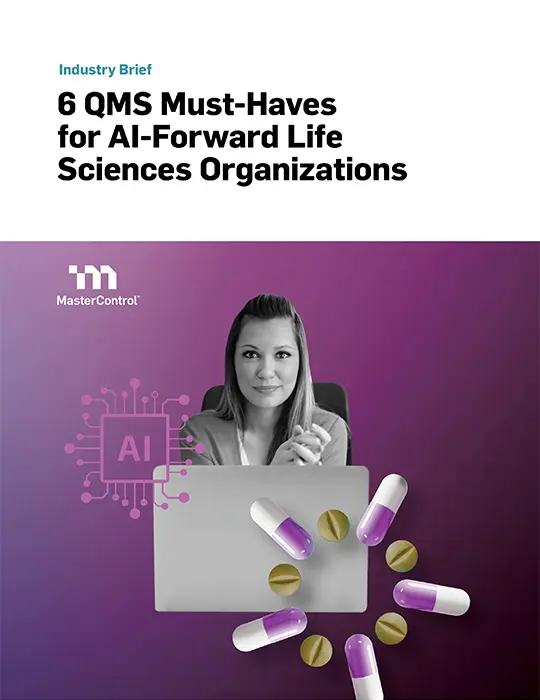
Ready to cut your quality cycle times by up to 90%? Download "6 QMS Must-Haves for AI-Forward Life Sciences Organizations" to discover how.
The True Cost of Documentation Bottlenecks
The financial impact of documentation inefficiencies often remains hidden, buried within operational budgets and accepted as an unavoidable cost of doing business in regulated environments. However, when fully quantified, these costs reveal themselves as substantial drains on profitability and competitive positioning.
Product launch delays represent perhaps the most costly consequence. When market entry is delayed due to documentation bottlenecks, organizations face significant lost revenue opportunities. Compliance risks from outdated procedures create another substantial hidden cost, as regulatory observations and warning letters frequently cite inadequate documentation as findings that require extensive remediation efforts.
Quality investigations stemming from procedural gaps create further financial drain. When procedures fail to adequately address operational requirements, the resulting deviations trigger investigations, corrective actions, and preventive measures that consume valuable resources.
As MasterControl's industry brief highlights, the U.S. Food and Drug Administration (FDA) states that "quality should be built into the product, and testing alone cannot be relied on to ensure product quality." This philosophy applies equally to documentation – quality must be built into the process, not merely inspected at the end.
Perhaps most insidious is the ongoing resource drain from manual review cycles. Document review requires multiple stakeholders across quality, regulatory, manufacturing, and subject matter experts, with each document potentially undergoing multiple revision cycles before approval. This resource commitment quickly escalates into significant labor hours that could otherwise be directed toward value-adding activities.
Common Failure Points in Traditional SOP Management
The journey of a pharmaceutical SOP from creation to implementation is fraught with inefficiencies and bottlenecks. Understanding these failure points is essential to recognizing where AI can deliver the greatest transformative impact.
Manual Authoring Challenges
Creating pharmaceutical SOPs traditionally begins with either a blank document or an outdated template that requires substantial modification. Authors—typically subject matter experts with limited documentation experience—struggle with consistency, often producing documents that vary widely in structure, terminology, and level of detail. This inconsistency impacts both usability and compliance efforts.
The limited availability of subject matter experts represents another critical bottleneck. These specialized personnel must balance their documentation responsibilities against their primary operational roles, often resulting in documentation tasks being repeatedly deprioritized.
Review and Approval Inefficiencies
Traditional review processes follow linear, sequential paths where documents move from one reviewer to the next. This approach means that any single delayed reviewer halts the entire process. When reviewers provide contradictory feedback, resolution requires additional cycles of review, further extending timelines.
Email-based approvals and feedback create additional complications through lost communications, version control challenges, and the absence of automated tracking mechanisms. When key reviewers are unavailable due to vacations, illness, or competing priorities, the process stalls indefinitely with no automated escalation or alternative routing.
Eliminate documentation bottlenecks with AI-enabled workflows. Learn how with "6 QMS Must-Haves for AI-Forward Life Sciences Organizations." [GET THE GUIDE]
Implementation and Training Hurdles
Even after a document receives final approval, significant challenges remain in implementation. Many traditional systems disconnect document approval from training assignments, creating gaps where approved procedures aren't promptly communicated to affected personnel.
For global pharmaceutical organizations, implementing procedures across regional operations presents additional complexities. Without systems that connect documentation to actual operational outcomes, quality teams have limited visibility into whether procedures are being followed consistently across all sites or are effectively achieving their intended purpose.
As one MasterControl customer, a quality specialist at Fagron, notes in the industry brief: "We're all [on] one site, and so everybody around the world is together. Now I can see the documents that Poland is working on and vice versa. We haven't had that flexibility until now."
How AI is Revolutionizing Pharmaceutical Documentation
Artificial intelligence is fundamentally transforming pharmaceutical documentation processes, addressing long-standing inefficiencies and enabling quality teams to shift from document managers to strategic quality partners.
AI-Powered SOP Generation
Modern quality management system platforms now incorporate intelligent templates that automatically align with regulatory requirements across multiple jurisdictions. These AI systems can suggest optimal structure, content components, and language that satisfy compliance requirements while maintaining clarity and usability.
Natural language processing (NLP) capabilities automatically scan drafted content for inconsistencies, regulatory gaps, or clarity issues. For organizations managing global operations, AI tools ensure procedural consistency across markets while adapting to local regulatory nuances.
According to the research in MasterControl's industry brief, "Integrating AI into your system elevates automation by learning from historical quality data to suggest optimal approval paths, identify potential bottlenecks before they occur, and even recommend corrective actions based on similar past events. This intelligent automation reduces human error while accelerating quality processes with human oversight."
Smart Review and Approval Workflows
AI-enabled quality management systems have transformed the traditionally linear review process by enabling intelligent parallel reviews with automatic consolidation of feedback. These systems analyze the nature of each procedural change to determine optimal reviewer routing, ensuring appropriate expertise without unnecessary approval layers.
When reviewers provide conflicting feedback, AI systems can highlight contradictions, suggest resolution approaches based on regulatory requirements, or escalate to designated decision-makers with contextual information. Automatic notification and escalation mechanisms prevent stalled reviews, with systems monitoring progress and redirecting workflows when bottlenecks occur.
The industry brief emphasizes that "With AI functionality embedded into your QMS, you can enter a quality event, investigate it, determine corrective action, approve new documents or changes to existing ones, and send out training automatically all in the QMS. This makes it very easy to show your process during an audit."
Transform your document management with AI-powered workflows. Download "6 QMS Must-Haves for AI-Forward Life Sciences Organizations" today.
Compliance Verification
AI-powered pharma QMS platforms continuously monitor regulatory changes across global markets, automatically flagging procedures that may require updates based on evolving requirements. This proactive approach replaces the reactive compliance model that has dominated pharmaceutical quality systems for decades.
Automated gap analysis between procedures and requirements helps quality teams prioritize documentation efforts based on compliance risk, ensuring resources focus on the most critical documentation needs.
Training Integration and Effectiveness
The integration of AI into training processes represents another transformative advancement. Modern systems automatically assign training based on role-specific needs when documents are approved, ensuring affected personnel promptly receive updated information.
The MasterControl brief highlights the impressive outcome mentioned above, UCSF Health's 50% improvement in training cycles after implementing the MasterControl Quality Excellence (Qx) solution. This real-world use case demonstrates the tangible benefits that connected AI QMS systems can deliver in accelerating critical quality processes.
Real-World Implementation Roadmap
Successfully implementing AI-enabled documentation processes requires a strategic approach that balances quick wins with sustainable transformation. Three key considerations for implementation are outlined below.
Assessment Phase
Organizations should begin by evaluating their current documentation landscape, including cycle times, resource requirements, error rates, and compliance vulnerabilities. This baseline assessment should identify critical bottlenecks where AI can deliver the greatest immediate impact.
Stakeholder alignment is essential during this phase, particularly engaging quality leadership, regulatory affairs, operations, and IT to build consensus around priorities and approaches.
Phased Implementation Approach
Most successful transformations begin with a focused pilot program targeting high-impact document types—typically those with frequent changes, significant compliance implications, or critical operational importance. This approach allows organizations to demonstrate value quickly while refining implementation strategies.
The industry brief notes that proper QMS implementation should allow you to "begin using the product with limited functionality and then expand your use" and "go live at a single site and then roll out to others."
Measuring early wins and communicating successes broadly helps build organizational momentum and support for wider implementation. As the program scales, organizations should continuously refine their approach based on lessons learned and evolving capabilities.
Change Management Considerations
Overcoming resistance to AI-assisted documentation requires thoughtful change management. Addressing concerns about job displacement by emphasizing how AI augments human capabilities rather than replaces them helps build acceptance.
Redefining roles and responsibilities to emphasize strategic quality oversight rather than document processing creates career advancement opportunities while improving operational effectiveness.
Measuring Success: Key Performance Indicators
Quantifying the impact of AI-enabled documentation systems requires tracking both implementation metrics and business outcomes.
Implementation Metrics
Document cycle time reduction provides the most visible immediate benefit when implementing AI-enabled systems. Resource hour savings can be tracked through time allocation studies comparing pre- and post-implementation effort requirements. Error reduction percentages—measured through deviation rates, inspection findings, and rework requirements—demonstrate quality improvements.
The research highlighted in the MasterControl's industry brief demonstrates the dramatic impact these systems can have: 90% reduction in investigation cycle time for deviations and nonconformances when companies use advanced analytics. This level of improvement optimizes organizations' response to quality events.
Business Impact Metrics
While operational metrics demonstrate efficiency gains, business impact metrics connect documentation excellence to strategic outcomes. Time-to-market acceleration for new products directly links to revenue generation. Audit readiness improvements can be measured through decreased preparation time and improved inspection outcomes.
The industry brief emphasizes that "The best way to build quality into a product is with an effective, connected digital QMS built to integrate the latest technology. This is the foundation for long-term regulatory compliance and market success."
Ready to transform your quality management system with AI? Get your copy of "6 QMS Must-Haves for AI-Forward Life Sciences Organizations" [ DOWNLOAD NOW]
Conclusion: The Future of Pharmaceutical Documentation
The transformation of pharmaceutical documentation through AI-enabled quality management systems represents more than procedural improvement—it fundamentally changes how life sciences organizations approach quality and compliance. By eliminating documentation bottlenecks, these systems free quality professionals to focus on strategic initiatives rather than administrative processes.
As AI capabilities continue to evolve, we can expect even greater integration between documentation systems and operational technologies. Organizations that embrace these capabilities now will establish significant competitive advantages in operational efficiency, regulatory agility, and product quality.
The documentation dilemma that has challenged pharmaceutical companies for decades now has a solution. As the industry brief aptly states: "An advanced QMS offers features to track, trend, and report on the data within the QMS... Forward-thinking vendors will offer predictive quality analytics... This type of predictive intelligence allows quality teams to shift from reactive problem-solving to proactive quality assurance, addressing issues before they impact products."
The question is no longer whether AI will transform pharmaceutical documentation, but which organizations will lead this transformation—and which will be left behind.
References:
1. "6 QMS Must-Haves for AI-Forward Life Sciences Organizations," MasterControl, 2025.

Manufacturing, Quality, and Asset Management — Simplified with Life Sciences-Specialized AI.
MasterControl Inc. is a leading provider of cloud-based quality and manufacturing software for life sciences and other regulated industries. For three decades, our mission has been the same as that of our customers – to bring life-changing products to more people sooner. MasterControl helps organizations digitize, automate, and connect quality and manufacturing processes. Innovative MasterControl tools have a proven track record of improving product quality, reducing cost, and accelerating time to market. Over 1,100 companies worldwide use MasterControl solutions to streamline operations, maintain compliance, easily analyze and interpret large amounts of data, and visualize business insights in real time.
Free Resource
Enjoying this blog? Learn More.
6 QMS Must-Haves for AI-Forward Life Sciences Organizations
Download Now