GxP Lifeline
6 Essential Capabilities in an AI-Powered Life Sciences QMS

What if your quality management system (QMS) could do more than store documents and track deviations? What if it could think, anticipate risks, streamline audits, and help you stay ahead of shifting EMEA regulations?
For many life sciences organisations, that reality is just that — a reality.
With artificial intelligence (AI) now embedded into leading digital QMS platforms, the role of the quality team is evolving from reactive problem-solvers to proactive stewards of compliance and innovation. Rather than replacing your expertise, AI tools are amplifying it.
Whether you're looking to reduce audit prep time, close corrective actions/preventive actions (CAPAs) faster, or improve visibility across your global operations, the right AI-powered features can transform how you manage quality.
Below, we'll explore six capabilities to look for in an AI-powered life sciences QMS — and how they can help you and your team navigate complexity and stay compliant in today's rapidly moving regulatory environment.
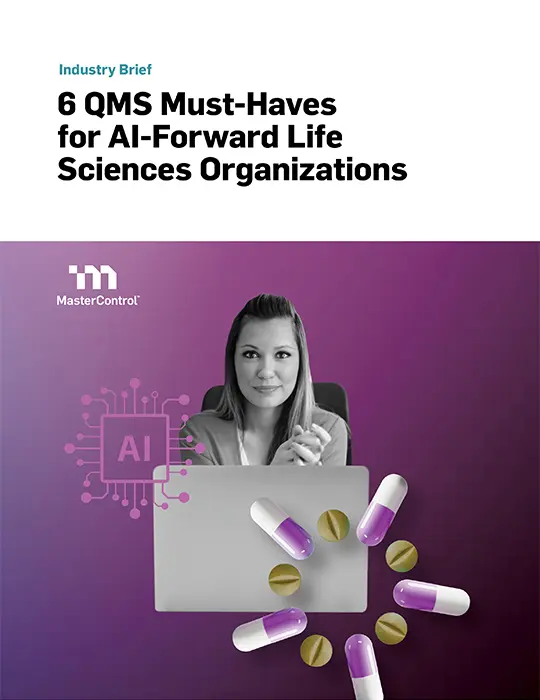
Want to see how forward-thinking organisations are using advanced QMS solutions to transform economic challenges into opportunities for competitive advantage? MasterControl's industry brief, 6 QMS Must-Haves for AI-Forward Life Sciences Organisations, explores this in more detail. Download the brief here.
Why Economic Pressures Are Reshaping Quality Management in EMEA Life Sciences
Quality teams across EMEA are operating under increasing economic strain. While regulatory complexity continues to grow, economic headwinds are forcing organisations to rethink how they manage compliance, often with fewer resources.
One of the biggest challenges: Rising operational costs. Inflation across the region has driven up expenses for everything from raw materials to skilled labour. At the same time, life sciences companies are under pressure to accelerate innovation and speed time-to-market without sacrificing quality or compliance. This creates a difficult balancing act, especially for quality teams tasked with doing more with less.
Labour shortages are further compounding the issue, with many markets across EMEA struggling to hire and retain talent with the right skills and salary requirements. As workloads increase and teams shrink, manual processes and siloed systems become even harder to sustain.
There's also the growing financial impact of noncompliance. Regulatory scrutiny is intensifying across the region, particularly in areas like data integrity, traceability, and postmarket surveillance. A single compliance failure can lead to fines, product recalls, and reputational damage — costs that can far exceed the price of prevention.
Ultimately, these challenges make the case that smarter, AI-enabled quality systems are not just compelling but essential.
Want more information on how companies with AI-enabled QMS are reducing quality costs while maintaining compliance? Check out MasterControl's industry brief: 6 QMS Must-Haves for AI-Forward Life Sciences Organisations.
6 Critical Capabilities for AI-Ready Quality Management in EMEA
Forward-thinking organisations are discovering that the right QMS can transform economic challenges into opportunities for a competitive advantage. Here's how six AIenabled capabilities within a digital QMS foster resilience and deliver real value under pressure.
1. Automation That Scales Without Proportional Cost Increases
AI-driven process automation — such as routing documents, resolving CAPAs, and monitoring deviations — dramatically cuts manual workload. McKinsey estimates AI could shorten time-to-market by 30%-50% in pharma processes, a substantial cost saver as project volumes grow alongside inflationary pressures.
Learn how automation capabilities detailed in the industry brief helped one organisation achieve a 90% reduction in investigation cycle time. Download MasterControl's industry brief here.
2. Connected Quality Processes That Reduce Redundancy
Disconnected systems and manual handoffs often lead to duplicated work, missed updates, and higher compliance risk. MasterControl's digital QMS unifies key quality processes — such as document control, training, change management, and CAPA — on a single platform. This connected approach streamlines operations, reduces delays, and ensures critical information flows freely across departments, helping teams stay focused on value-added activities.
The industry brief explains how connected quality systems create closed-loop quality management that eliminates costly gaps. Read now.
3. Analytics That Drive Cost-Effective Decision-Making
Real-time analytics and predictive models turn data into insights, helping teams prioritise high-risk areas and allocate resources strategically. A modern, AI-enabled digital QMS enables smarter decisionmaking around hiring, audit focus, or inventory based on historical trends and forecasts.
MasterControl's industry brief explains how robust analytics capabilities are transforming reactive quality into proactive, cost-saving operations. Download the industry brief here.
4. Flexibility That Adapts to Market Volatility
With inflation, supply chain disruptions, and fluctuating regulatory demands, flexible systems are essential. AI-enabled QMS platforms can adapt standard operating procedures (SOPs), workflows, and compliance checkpoints on-the-fly without heavy customisation, making them more resilient to change.
The industry brief outlines four levels of scalability that protect your QMS investment during economic uncertainty. Discover the four levels here.
5. Audit Efficiency That Reduces Compliance Costs
AI tools streamline audit preparation by autosorting documents, identifying missing evidence, and prescoring risk areas. These features can slash audit prep by as much as 50%, reducing both internal burden and external consultant fees.
Find out how one organisation achieved a 50% improvement in training cycles with an AI-enabled QMS in MasterControl's industry brief, 6 QMS Must-Haves for AI-Forward Life Sciences Organisations.
6. Validation Strategies That Lower Operational Costs
Traditional validation can be a heavy lift — costly, time-consuming, and resource intensive. Digital QMS with AI-assisted validation reuses test assets intelligently, surfaces noncompliant areas early, and maintains audit trail integrity — cutting operational burdens dramatically.
Learn about innovative validation approaches that have dramatically reduced average validation time, as detailed in the industry brief. Read here.
AI as an Economic Multiplier in Uncertain Times
Automation, connected processes, real-time analytics — these capabilities aren't just about efficiency; they're about adaptability. In a market defined by unpredictability, AI-powered tools act as a multiplier for quality teams, helping them respond faster, work smarter, and maintain control even as conditions shift.
Whether it's regulatory updates, supply chain disruptions, or staffing constraints, AI makes it easier to pivot without losing momentum. For example, predictive analytics can flag emerging risks before they escalate, while automated workflows keep critical processes moving even when resources are stretched. That agility is much needed in today's volatile environment.
AI isn't just supporting digital transformation — it enables economic resilience. When applied strategically within a digital QMS, it helps life sciences companies in EMEA stay compliant, control costs, and turn uncertainty into opportunity.
Want more information? The industry brief explores how AI is helping quality teams do more with less while improving outcomes. Read more.
Practical Steps for Rolling Out a Digital QMS on a Budget
For many life sciences companies, the benefits of AI-powered quality management are clear. However, implementation can feel daunting, especially when teams are already stretched thin. The good news: You don't need massive resources to make meaningful progress.
By focusing on strategic, phased implementation, even resource-constrained organisations can begin realising the value of a digital QMS. Here are a few best practices to guide the way:
- Start with the highest-impact processes where automation will save the most time, like document routing, CAPA tracking, or audit prep.
- Leverage preconfigured templates and workflows; take advantage of built-in tools to reduce setup time and ease user adoption.
- Focus on data readiness early to take full advantage of AI capabilities.
- Train teams in waves to reduce disruption and improve retention.
- Work with vendors that understand regulatory demands with deep life sciences expertise and a track record of supporting EMEA compliance.
- Track success with clear metrics and key performance indicators (KPIs) to prove ROI and gain buy-in for future phases.
With the right strategy, even small steps toward AI-powered quality can deliver measurable impact without overloading your team. Discover how organisations are implementing these six critical capabilities even with limited budgets in MasterControl's industry brief: 6 QMS Must-Haves for AI-Forward Life Sciences Organisations.
Smarter, AI-Enabled Quality Starts Here
Companies across the EMEA life sciences sector are under immense pressure to reduce costs, maintain compliance, and respond to constant change — all with limited resources. But those embracing AI-enabled quality systems are finding a surprising truth: compliance doesn't have to be at odds with economic efficiency.
Instead of slowing teams down, the right digital QMS speeds them up — automating routine tasks, improving visibility, and empowering smarter decisions across the board. It's a shift from reactive quality management to proactive, strategic control. And it's already happening in organisations that have made AI a cornerstone of their quality strategy.
Ready to see what this looks like in practice? Download MasterControl's industry brief, 6 QMS Must-Haves for AI-Forward Life Sciences Organisations, to explore the capabilities and strategies driving this transformation across the industry.

Manufacturing, Quality, and Asset Management — Simplified with Life Sciences-Specialized AI.
MasterControl Inc. is a leading provider of cloud-based quality and manufacturing software for life sciences and other regulated industries. For three decades, our mission has been the same as that of our customers – to bring life-changing products to more people sooner. MasterControl helps organizations digitize, automate, and connect quality and manufacturing processes. Innovative MasterControl tools have a proven track record of improving product quality, reducing cost, and accelerating time to market. Over 1,100 companies worldwide use MasterControl solutions to streamline operations, maintain compliance, easily analyze and interpret large amounts of data, and visualize business insights in real time.
Free Resource
Enjoying this blog? Learn More.
6 QMS Must-Haves for AI-Forward Life Sciences Organisations
Download Now