
The Business Case for Manufacturing Readiness: Why Compliance Is a Competitive Advantage
When life sciences executives talk about manufacturing readiness, the conversation usually centers on risk: What will the inspector find? How many Form 483 observations will we get? Are we exposed? It's a defensive mindset, and it's understandable. But it misses something important.
Manufacturing readiness is also one of the most underappreciated competitive advantages in life sciences today. The organizations that invest in compliant manufacturing aren't just protecting themselves from regulatory action. They're accelerating product release, reducing operational costs, and building a manufacturing floor that performs better under inspection pressure and normal conditions alike. The question for decision-makers isn't only "Are we ready for our next audit?" It's "Is our floor giving us an edge?"
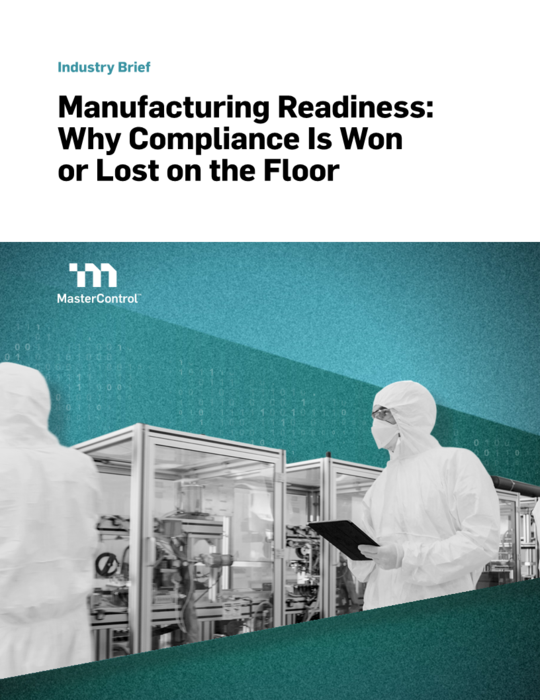
Want to see the full picture? MasterControl's industry brief, "Manufacturing Readiness: Why Compliance Is Won or Lost on the Floor," lays out the business case for digital manufacturing readiness in detail. Download it here.
The Hidden Cost of Paper You're Already Paying
Most manufacturing leaders know paper-based batch records are inefficient. What they may not fully appreciate is the scale of what that inefficiency costs them. Paper-based batch records consume days in review processes where hours matter. Manual data entry introduces errors that require costly rework. Siloed systems obscure visibility across production lines and shifts. When an inspector asks a question, the answer lives somewhere in a filing cabinet or on a server that isn't connected to anything else.
Consider what one quality leader faced. BioBridge Global, a non-profit blood center and cell therapy manufacturing organization, was working with batch records that ran 400 to 500 pages with over 2,000 to 3,000 manual entry points. As their Executive Director of Global Quality, Emmanuel Casasola, was quoted in MasterControl’s Manufacturing Readiness industry brief: "Each one of those entry points is an opportunity for failure."
That's not just a compliance risk. It's a productivity drain, a quality bottleneck, and a competitive disadvantage rolled into one.
What "Quality at the Source" Really Means
The concept of "Quality at the Source" gets a lot of attention in life sciences manufacturing, but the brief makes a sharp distinction: connected quality and manufacturing systems don't just improve efficiency. They make compliance the default state.
When your electronic batch records (EBRs) are linked directly to your quality management system (QMS), several things happen simultaneously:
Deviation management is embedded in production execution rather than handled after the fact.
Training verification happens automatically when an operator badges into the system.
Enforcement of standard operating procedures (SOPs) is built into the workflow so only qualified personnel access controlled procedures.
Audit trails become continuous instead of requiring manual reconstruction.
This connected model isn't just an efficiency play. It's an audit readiness strategy. Every connection closed between quality and manufacturing is a documentation gap eliminated and a Form 483 observation prevented before it can take form.
The brief walks through exactly how connected manufacturing-quality systems work in practice, with real-world examples from manufacturers who've made the transition. Get the details here.
The Numbers That Matter to Executives
Here's where the business case gets concrete. Cirtec Medical, a leading contract manufacturer of continuous glucose monitoring sensors, earned the 2025 Digital Transformation in Manufacturing Award for expanding connected quality and manufacturing operations across multiple sites. Their results:
Average review and release times dropped from 17.28 hours to 3.12 hours — an 82% reduction.
Nearly 223,000 hours in cumulative time savings through native automation.
Productivity and performance gains that encapsulate what's possible when quality and manufacturing work as one integrated system.
For executives evaluating where to invest, the implication is clear. Manufacturing compliance isn't a cost center. When implemented through connected digital systems, it's a productivity engine.
Curious what these results could look like for your operation? The brief includes the full Cirtec Medical story along with additional manufacturer case studies. See the numbers for yourself.
The Fastest Path to Digital Maturity
Not every organization is ready to deploy a full manufacturing execution system (MES) overnight. The good news is that you don't have to. Electronic logbooks offer the fastest path to digital maturity on the manufacturing floor, delivering measurable value in four to six weeks compared to the nine to 12 months typically required for a full QMS or MES implementation.
That means your organization can begin capturing real ROI in weeks, not quarters. And when an inspector asks for a reconstruction of the history of a specific device or lot, the genealogy query takes seconds, not hours.
For teams evaluating their manufacturing readiness, the brief includes a practical self-assessment checklist covering the areas inspectors scrutinize most:
EBR or electronic device history record (eDHR) implementation across production lines.
Electronic logbook deployment for equipment, cleaning, and environmental monitoring.
Equipment calibration and qualification records that are current and electronically traceable.
QMS and EBR connectivity so deviations link directly to batch records.
Training verification before operators execute controlled procedures.
Batch release decisions supported by real-time, system-generated data.
The Strategic Shift: From Defense to Advantage
The organizations pulling ahead in life sciences manufacturing aren't treating compliance as a defensive obligation. They're treating manufacturing readiness as a strategic investment. The same systems that ensure compliant manufacturing also shorten review cycles, eliminate manual rework, and give leaders real-time visibility into production performance.
The brief frames it plainly: digital manufacturing execution doesn't just improve efficiency. It makes compliance the default state. And connected quality and manufacturing systems close the documentation loops that create inspection risk.
For manufacturing professionals and executives, the takeaway is straightforward. Your floor is either a liability that drains resources and invites citations, or it's an integrated, data-driven operation that gives you a measurable edge. The difference comes down to whether you treat manufacturing readiness as a checkbox or a strategy.
Ready to assess where your manufacturing operations stand? Download MasterControl's industry brief, "Manufacturing Readiness: Why Compliance Is Won or Lost on the Floor," for the full business case, manufacturer case studies, regulatory framework breakdown, and a self-assessment tool you can put to work immediately. Download the brief now.

Manufacturing, Quality, and Asset Management — Simplified with Life Sciences-Specialized AI.
MasterControl Inc. is a leading provider of cloud-based quality and manufacturing software for life sciences and other regulated industries. For three decades, our mission has been the same as that of our customers – to bring life-changing products to more people sooner. MasterControl helps organizations digitize, automate, and connect quality and manufacturing processes. Innovative MasterControl tools have a proven track record of improving product quality, reducing cost, and accelerating time to market. Over 1,100 companies worldwide use MasterControl solutions to streamline operations, maintain compliance, easily analyze and interpret large amounts of data, and visualize business insights in real time.
Follow Us
Industry Brief
Enjoying this blog? Learn More.
Manufacturing Readiness: Why Compliance Is Won or Lost on the Floor