
Where Compliance Is Won or Lost: Is Your Manufacturing Floor Ready?
Picture this: a U.S. Food and Drug Administration (FDA) investigator has just arrived at your facility. They exchange pleasantries at the front desk, accept the obligatory escort, and then — before anyone has time to prepare — they head straight for the manufacturing floor. Not your quality management system (QMS) dashboard. Not the conference room where your quality team has a polished slide deck ready to go. The floor.
It's a scenario that plays out at life sciences facilities every day, and it reveals a truth that too many organizations learn the hard way: manufacturing readiness is not a document-management problem. It's an execution problem. The regulatory risk that leads to warning letters, Form 483 observations, and consent decrees doesn't primarily originate in your quality system. It originates where your products are actually made. The manufacturing floor is where data is created. And, critically, where it is most vulnerable. The gap between compliance intent and execution reality is precisely where inspectors consistently find their citations.
The encouraging news? Understanding where the risk lives is the first step toward eliminating it. Thankfully, the same digital systems that make your manufacturing operations more efficient are the ones that can make compliant manufacturing nearly automatic.
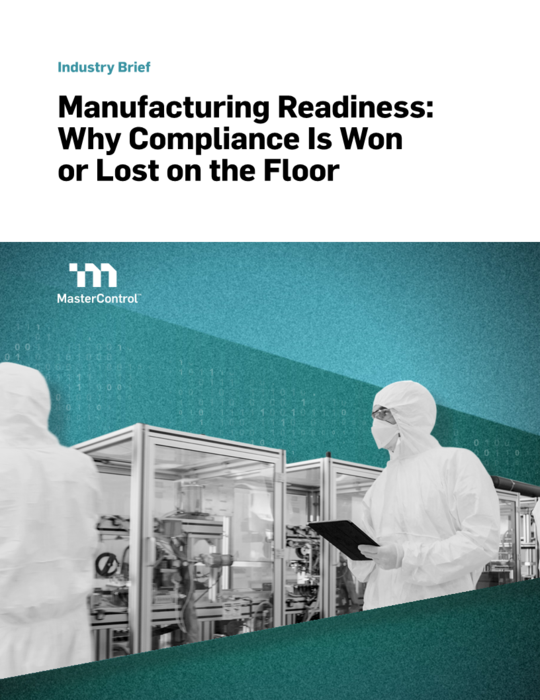
Want the full picture? MasterControl's new industry brief, "Manufacturing Readiness: Why Compliance Is Won or Lost on the Floor," breaks down exactly what's at stake and what you should do about it. Download it here.
The Floor Is Where the Data Lives, and Where It's Most Exposed
If you've been watching FDA enforcement trends, none of this will surprise you: data integrity violations have made up a significant share of recently issued FDA warning letters, and that enforcement focus shows no signs of reversing. The manufacturing floor is the primary source of ALCOA++ citations. And it's not difficult to understand why.
Consider what compliance and quality professionals sometimes call the "Human API" problem. When manufacturing managers are manually bridging paper records and digital systems — transcribing data from one place to another, reconciling timestamps after the fact, filling in fields from memory — they inadvertently introduce exactly the kinds of errors inspectors are trained to find: transcription mistakes, timing discrepancies, and attribution gaps that are all citable failures. No one intends for these gaps to exist. They're a predictable byproduct of systems that weren't designed for manufacturing compliance in the first place.
The question isn't whether your team is trying to do the right thing. It's whether your systems make the right thing the path of least resistance.
When Paper Meets Process: The Hidden Compliance Gaps You're Probably Living With
Here's a difficult truth about paper-based manufacturing records: even when your team follows them diligently, they create structural vulnerabilities that put your organization at risk. Paper exposes you to a well-documented set of ALCOA++ failures, including:
Missing entries — a momentary lapse that becomes a documentation gap.
Illegible handwriting — unreadable records are uncitable records.
Version mismatches — using a superseded standard operating procedure (SOP) because someone printed it before an update was distributed.
Inability to trend — no search, no signal, no early warning.
Backdating — implausible but often unprovable, and always a red flag.
The SOP drift issue is especially acute in multi-shift and multi-site environments. When procedures are updated and paper copies are already in circulation, the version mismatch doesn't just create confusion, it creates a Form 483 observation waiting to happen.
Equipment readiness is another frequently cited inspection gap, and the root cause often isn't a lack of qualified equipment. It's incomplete or fragmented documentation. Regulations including 21 CFR 211, the Quality Management System Regulation (QMSR), and EU GMP Annex 11 all have direct, parallel documentation requirements for manufacturing operations. And paper-based systems struggle to keep pace with all of them simultaneously.
Our industry brief maps every one of these risk areas to the specific regulatory requirements inspectors use to cite them — across QMSR, 21 CFR Parts 210–211, EU GMP, and ALCOA++. Get the brief here.
What Changes When You Go Electronic, and Why It Matters More Than You Think
The shift from paper to electronic manufacturing records doesn't just make things faster or easier to find. It fundamentally changes the architecture of manufacturing compliance. When operators execute batch records in an electronic system, compliance is no longer something they opt into — it's something the system enforces by design:
Timestamps lock automatically at the moment of entry.
Required fields must be completed before the next step can begin.
User attribution is tied directly to system login — no gaps, no guesswork.
One of the most powerful capabilities this shift unlocks is review by exception. Instead of a quality reviewer combing through a 200-page batch record line by line, they see only what needs their attention: out-of-range values, missed entries, escalated deviations. The signal-to-noise ratio improves dramatically, and so does the speed and accuracy of your release process.
For organizations looking for a faster path to digital maturity on the floor, electronic logbooks are worth prioritizing. They deliver measurable value in weeks — far sooner than the months typically required for a full QMS or manufacturing execution system (MES) implementation. Real-world results from manufacturers who've made this transition tell a compelling story — one that our industry brief captures in detail.
Curious what this looks like in practice? The brief includes a real-world breakdown of what manufacturers have achieved — including dramatic reductions in batch record review time. See the numbers for yourself.
The Inspection Checklist Your Team Wishes It Had
So what exactly are inspectors looking for when they walk your floor? Manufacturing compliance requirements span multiple regulatory frameworks, and each one has its own specific expectations for how records are created, managed, and maintained. MasterControl's industry brief provides a detailed breakdown across:
QMSR — for medical device manufacturers.
21 CFR Parts 210–211 — for pharmaceutical manufacturers.
EU Good Manufacturing Practice (GMP).
ALCOA++ — the data integrity standard that cuts across all of the above.
The new Form 483 response standard — what regulators now expect to see when observations are cited.
What you'll also find in the brief is a look at how integrating your QMS with electronic batch records (EBR) can embed compliance checkpoints — including training verification and SOP enforcement — directly into the production workflow. When an operator badges into the system, their training status is verified automatically. They access only the procedures they're qualified to execute. Compliance happens at the point of execution, not after the fact in a corrective action report.
The brief also includes a self-assessment tool designed to help you evaluate your own manufacturing readiness across the most commonly cited inspection areas — a practical resource your team can put to work immediately.
It Starts on the Floor. So Does the Fix.
Manufacturing is where compliance intent meets execution reality. This has always been true. What's changed is that the tools now exist to close that gap at scale — and to do it in a way that makes compliant manufacturing a byproduct of doing your job well, rather than a separate effort layered on top of it.
The organizations getting this right aren't just surviving inspections. They're operating with confidence, releasing product faster, and building quality into every step of production, not scrambling to document it afterward.
Your manufacturing floor is either your greatest compliance liability or your strongest competitive advantage. The difference comes down to preparation.
Ready to find out where your manufacturing operations stand? Download MasterControl's industry brief, "Manufacturing Readiness: Why Compliance Is Won or Lost on the Floor," for a complete framework, regulatory breakdown, and self-assessment tool built for life sciences manufacturers. Download the brief now.
What You Should Do Next
Subscribe to the GxP Lifeline newsletter to access other informative articles like this one.
Contact us to get answers for your software, quality, and compliance questions.

Manufacturing, Quality, and Asset Management — Simplified with Life Sciences-Specialized AI.
MasterControl Inc. is a leading provider of cloud-based quality and manufacturing software for life sciences and other regulated industries. For three decades, our mission has been the same as that of our customers – to bring life-changing products to more people sooner. MasterControl helps organizations digitize, automate, and connect quality and manufacturing processes. Innovative MasterControl tools have a proven track record of improving product quality, reducing cost, and accelerating time to market. Over 1,100 companies worldwide use MasterControl solutions to streamline operations, maintain compliance, easily analyze and interpret large amounts of data, and visualize business insights in real time.
Follow Us
Industry Brief
Enjoying this blog? Learn More.
Manufacturing Readiness: Why Compliance Is Won or Lost on the Floor