
Regulatory Readiness: Why the Old Compliance Playbook Doesn’t Work in 2026
You've navigated regulatory changes before. New guidance drops. Enforcement priorities shift. Inspection expectations evolve. You adjust, update your standard operating procedures (SOPs), retrain your teams, and move on. For decades, that's been the rhythm of compliance and the approach to regulatory readiness in life sciences.
But 2026 is different, and not just because one major regulation changed. It's because several significant regulatory changes arrived at the same time, across multiple frameworks, in multiple jurisdictions. If you've been feeling like the ground is shifting underneath you, that instinct is correct. The scale and speed of what's happening right now is unlike anything most quality and compliance teams have ever faced before.
Regulatory readiness has always mattered. But this year, it's become the defining competitive advantage. And if your current approach was built for a slower-paced, more predictable environment, it may not be enough anymore.
The good news is that there's a smarter way to operate. And we've mapped it out.
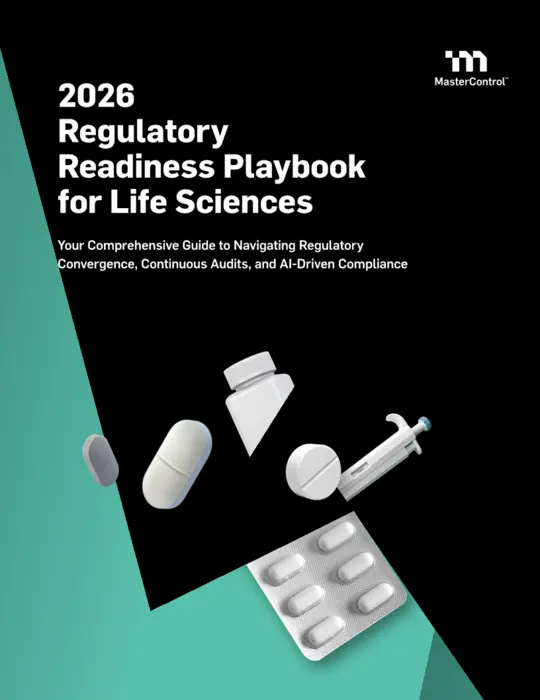
Download the free 2026 Regulatory Readiness Playbook for Life Sciences
A New Regulatory Reality: What Changed and Why It Matters
To understand why this moment demands a different kind of compliance strategy, it helps to see just how much has changed in such a short period of time:
The U.S. Food and Drug Administration (FDA) published its first-ever draft guidance on Form 483 responses in March 2026, raising the bar for how manufacturers are expected to address and document inspection findings.
The Quality Management System Regulation (QMSR) took effect February 2, 2026, aligning FDA medical device quality requirements with the internationally recognized ISO 13485 standard for the first time in history. This isn't a procedural update; it's a structural shift in how the FDA expects quality systems to be built and demonstrated.
The Computer Software Assurance (CSA) guidance was revised twice — once in September 2025 and again in February 2026 — replacing the traditional validation paradigm with a risk-based, least-burdensome model.
The EMA is moving toward formal adoption of revised EU GMP Chapter 4, a revised Annex 11, and a brand-new Annex 22 specifically addressing artificial intelligence (AI) and machine learning (ML) systems in good manufacturing practice (GMP) environments.
The EU AI Act is on track to be finalized in August 2026, classifying certain life sciences applications as "high-risk AI" subject to conformity assessments and ongoing monitoring requirements.
Taken individually, any one of these changes would demand attention. Together, they represent something bigger: a regulatory convergence across FDA, European Medicines Agency (EMA), and ISO frameworks that demands unified compliance strategies, not siloed responses to each update in isolation.
Navigating this landscape requires more than staying current on life sciences regulatory guidelines. It requires rethinking how compliance gets built into your organization from the ground up.
Find out how leading manufacturers are preparing for this new environment. Download the free Regulatory Readiness Playbook.
The Inspection-Prep Mindset Is Outdated
Here's something the industry doesn't say loudly enough: the traditional approach to preparing for inspections is a liability.
For years, "audit readiness" has meant a 90-day sprint that involves pulling records, chasing down documentation, resolving version control issues, and hoping nothing surfaces that wasn't already on the radar. It's stressful, and it's expensive. More importantly, it's increasingly insufficient.
Early QMSR inspection data published in April 2026, which is covered in depth in the Regulatory Readiness Playbook, makes this unmistakably clear. FDA findings are no longer evaluated as isolated procedural gaps. They're cross-functional, interconnected, and assessed in a systems context. Inspectors aren't just asking whether a procedure exists. They're asking whether your entire quality system functions as a coherent, integrated whole.
That's a fundamentally different question, and it requires a fundamentally different kind of readiness.
The manufacturers who will come through this period in the strongest position are the ones who have built compliance into how they work, rather than bolting it on before an audit. Continuous regulatory readiness isn't just a best practice anymore. It's the new standard.
Our Regulatory Readiness Playbook was built to help you get there step by step with practical guidance grounded in what regulators are actually looking for.
What's Actually Driving Your Compliance Risk
Before you can close your compliance gaps, you must be able to see them clearly. Some of the biggest risks aren't the ones that show up in warning letters, they're hiding in ordinary day-to-day operations.
Consider what's happening right now in too many manufacturing environments:
On the production floor: Paper-based batch records slow review cycles to a crawl. Manual data entry introduces errors that require costly investigation and rework. Siloed systems create visibility gaps across production lines and shifts, and when an inspector asks a question, the answer is somewhere in a filing cabinet or on a disconnected server.
In quality operations: Many quality teams are still largely reactive and often organized around responding to deviations and findings after they've materialized, rather than preventing them before they occur.
Across sites and shifts: SOP drift is a persistent vulnerability in multi-shift and multi-site environments. When procedures are updated, the wrong version gets used because someone printed a copy before the change went live or a satellite facility simply didn't receive the update in time.
These aren't edge cases. They're the everyday reality for a significant portion of the industry. And under the new inspection paradigm, where systems are evaluated holistically, they're exactly what regulators are trained to find.
Our regulatory readiness playbook addresses each of these vulnerabilities directly, and the solutions may be simpler to implement than you'd expect.
Download the 2026 Regulatory Readiness Playbook for free to see how.
AI Is Changing Compliance. From Both Sides.
No conversation about regulatory readiness in 2026 is complete without addressing artificial intelligence. And it's not a future-state concern; it's a present-tense compliance reality.
Regulators are actively building governance frameworks for AI in manufacturing and quality:
ISO/IEC 42001:2023 establishes the international standard for AI management systems across highly regulated industries, including life sciences.
EMA's new Annex 22 directly addresses AI and ML systems in GMP environments.
The EU AI Act, finalizing this August, is creating new compliance obligations for high-risk AI applications in life sciences.
But AI isn't just something regulators are scrutinizing, it's also one of the most powerful tools available to compliance teams. Manufacturers who understand how to govern AI responsibly and deploy it strategically are transforming compliance from a reactive burden into a proactive, continuous capability.
AI literacy is rapidly becoming a core competency for quality organizations. Our ultimate regulatory playbook covers both sides of this equation in depth.
Ready to Move From Inspection Prep to Continuous Readiness?
What we've covered here is just the opening chapter of a much larger story.
MasterControl’s 2026 Regulatory Readiness Playbook for Life Sciences is a strategic operating guide, not a generic compliance checklist. It was designed for quality and manufacturing professionals, operations leaders, decision-makers, and executives who are ready to build something more durable than a pre-audit sprint. Inside, you'll find:
A clear-eyed breakdown of what’s changing across the regulatory landscape and what inspectors are looking for under the new frameworks.
Honest tools and frameworks to assess where your compliance posture actually stands.
A practical model for building continuous readiness into everyday operations.
A globally applicable regulatory readiness blueprint with actionable checklists you can put to use immediately.
The companies that come out strongest won't necessarily be the largest or best-resourced. They'll be the ones that made compliance part of how they work, so that every audit becomes a confirmation of work already well done, rather than a crisis to manage.
Get the free 2026 Regulatory Readiness Playbook for Life Sciences
What You Should Do Next
Subscribe to the GxP Lifeline newsletter to access other informative articles like this.
Contact us to get answers for your software, quality, and compliance questions.

Manufacturing, Quality, and Asset Management — Simplified with Life Sciences-Specialized AI.
MasterControl Inc. is a leading provider of cloud-based quality and manufacturing software for life sciences and other regulated industries. For three decades, our mission has been the same as that of our customers – to bring life-changing products to more people sooner. MasterControl helps organizations digitize, automate, and connect quality and manufacturing processes. Innovative MasterControl tools have a proven track record of improving product quality, reducing cost, and accelerating time to market. Over 1,100 companies worldwide use MasterControl solutions to streamline operations, maintain compliance, easily analyze and interpret large amounts of data, and visualize business insights in real time.
Follow Us
e-book
Enjoying this blog? Learn More.
2026 Regulatory Readiness Playbook for Life Sciences