
How Leading CGT Manufacturers Are Turning Regulatory Demands Into Innovation Drivers
Cell and gene therapies (CGTs) are rewriting what modern medicine can do for patients. From addressing rare genetic diseases to offering potential cures for conditions once considered untreatable, the science has never been more promising. But as CGT manufacturing organizations move from clinical development into commercial-scale production, a new and very real challenge takes center stage: how do you build operations that can scale without compromising compliance, quality, or speed?
That's the question a panel of CGT manufacturing experts tackled head-on in a recent webinar — and the answers that emerged from the conversation are ones every manufacturing leader in this space needs to hear. Hosted by Life Science Connect, MasterControl, and Cell & Gene, the panel brought together two regulatory and manufacturing specialists in a frank discussion about the complex, fast-moving world of CGT regulations and an exploration of what it actually takes to transform compliance pressures into a genuine competitive advantage.
We've captured the most important takeaways in a new industry brief. And you can read it right now.
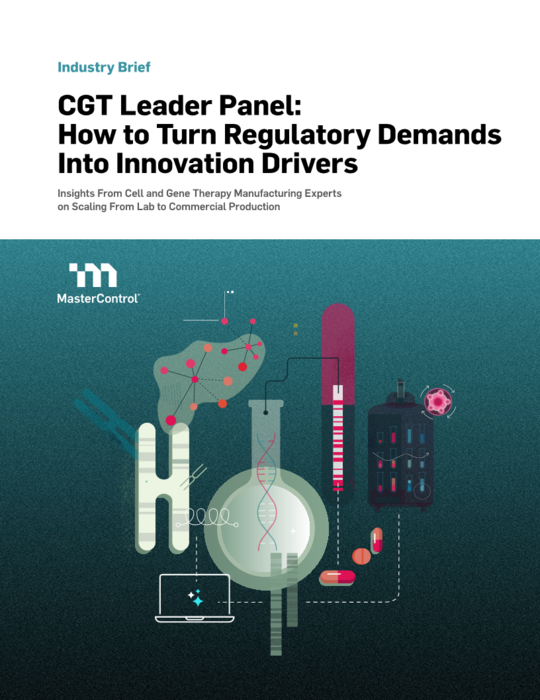
The expert insights are ready for you. Read the free, ungated industry brief — “CGT Leader Panel: How to Turn Regulatory Demands Into Innovation Drivers” — and discover what's working for CGT manufacturers right now. Read the Brief.
The Regulatory Landscape Is Shifting — and That's Actually Good News
If your team treats CGT regulatory requirements as a constantly moving target, you're not wrong. CGT regulatory guidance continues to evolve. But here's what manufacturers often miss: that evolution is increasingly working in your favor.
The panel discussion digs into exactly what that means in practice. Far from standing in the way of innovation, regulatory agencies are working to reduce late-stage friction by making their expectations clearer earlier in the development process. For manufacturers preparing investigational new drug applications, this shift creates meaningful opportunities for early engagement that many companies are still leaving on the table.
The panelists also highlighted the specific areas where CGT regulatory guidance is sharpening its focus — areas every CGT manufacturer should be actively addressing today:
Potency assays — and when to build them into autologous cell therapy development.
Chain of custody digitization — now a non-negotiable for product traceability and patient safety.
Digitalized records — the clear direction of travel for meeting data integrity expectations.
Modern manufacturing execution systems (MES) — purpose-built for enhanced traceability and real-time oversight.
These aren't future-state recommendations. They're current expectations. And as the panelists made clear, companies that embed regulatory thinking into their platform design early are the ones successfully keeping pace.
Want the complete breakdown of where CGT regulatory guidance is heading and what your team should be prioritizing right now? It's all in the brief. Access “CGT Leader Panel: How to Turn Regulatory Demands Into Innovation Drivers.”
The Batch-of-One Problem: GMP Meets a Completely New Reality
Here's a challenge the industry doesn't always discuss openly enough. CGT manufacturing — particularly autologous cell therapy manufacturing — is fundamentally patient-specific. Every batch is, in essence, a batch of one. And traditional good manufacturing practice (GMP) frameworks simply weren't built for that reality.
The panel addressed this tension directly: how do you maintain consistency, reduce operator variability, and satisfy CGT manufacturing regulations when no two production runs are ever truly identical? The strategies the panelists shared are practical and grounded in what leading manufacturers are doing right now. But we'll let the brief do the explaining on that front.
What we will say is this: the approaches that are working share a common thread. They combine closed, automated systems with smart digitalization and a deliberate approach to process standardization — tailored, as the panelists emphasized, to the specific requirements of each individual drug product.
One particularly compelling example the panel surfaced was the connection between digital batch records and deviation trend analysis. When your systems are actually talking to each other, patterns emerge — the kind that enable root cause analysis and help prevent recurring quality issues before they escalate. That's a different kind of compliance posture than most organizations are operating with today.
Why Digital Transformation in CGT Manufacturing Keeps Stalling
Here's a truth worth saying out loud: resistance to digital transformation in CGT manufacturing environments is rarely about the technology itself. It's about perceived risk. Teams operate in highly controlled, inspection-sensitive environments where any change — even a beneficial one — can feel like it's inviting trouble.
The panelists named the real barriers honestly:
Cost — not just the systems themselves, but the training, implementation, and ongoing commitment needed to make them work.
Competing priorities — early-stage companies often keep clinical timelines front and center, with infrastructure investment perpetually deprioritized.
Cultural resistance — changing deeply embedded workflows in high-stakes production environments is genuinely hard.
These are real obstacles. But here's the reality check: digital transformation in CGT manufacturing is no longer a competitive differentiator — it's a baseline requirement. The cost of delay is compounding as the CGT industry accelerates toward commercial scale, and the window for building a strong foundation before scaling pressure forces the issue is narrowing.
The path forward, as the webinar on CGT regulations and manufacturing made clear, follows a logical and achievable progression — from digital document management to connected manufacturing execution systems, and ultimately to full end-to-end orchestration across quality, manufacturing, and asset management.
Wondering how other CGT manufacturers are overcoming these barriers and moving forward? The strategies are in the brief. Read CGT Leader Panel: How to Turn Regulatory Demands Into Innovation Drivers.
What the Next Phase of CGT Manufacturing Looks Like
The panel didn't just diagnose today's challenges — they looked ahead. Three key trends emerged from the discussion as critical for the industry's continued evolution, and at least one of them involves a technology that's showing up across the entire CGT manufacturing lifecycle in ways that go well beyond early experimentation.
The panelists also touched on a genuinely exciting frontier — one with significant implications for how manufacturers think about their operational data and its potential role in future regulatory decisions. It's the kind of forward-looking insight that changes how you approach data capture today, not three years from now.
We're not going to get into the specifics here. That's exactly what the brief is for.
The CGT Foundation That Changes Everything
Great CGT science doesn't scale by itself. It scales on the back of connected people, processes, and quality systems working together in real time. The insights from this expert panel are clear: organizations that will lead in commercial CGT manufacturing are the ones building their digital foundation now — before scaling pressure makes it an emergency.
A connected digital platform transforms CGT manufacturing regulations from a compliance burden into a driver of operational excellence and, ultimately, a competitive advantage. The path to getting there is more achievable than most teams realize. And the roadmap is in the brief.
Don't wait for scale to force the issue. Get the expert insights your team needs to build a smarter digital foundation today. Download and read “CGT Leader Panel: How to Turn Regulatory Demands Into Innovation Drivers” or watch the webinar.

Manufacturing, Quality, and Asset Management — Simplified with Life Sciences-Specialized AI.
MasterControl Inc. is a leading provider of cloud-based quality and manufacturing software for life sciences and other regulated industries. For three decades, our mission has been the same as that of our customers – to bring life-changing products to more people sooner. MasterControl helps organizations digitize, automate, and connect quality and manufacturing processes. Innovative MasterControl tools have a proven track record of improving product quality, reducing cost, and accelerating time to market. Over 1,100 companies worldwide use MasterControl solutions to streamline operations, maintain compliance, easily analyze and interpret large amounts of data, and visualize business insights in real time.
Follow Us
Industry Brief
Enjoying this blog? Learn More.
CGT Leader Panel: How to Turn Regulatory Demands Into Innovation Drivers