
The First QMSR Warning Letters Just Dropped: Here's How to Stay Audit-Ready
The U.S. Food and Drug Administration (FDA) has posted its first warning letters based on Quality Management System Regulation (QMSR) audits, and the headline finding is clear: risk management. The early enforcement actions under the new QMSR zero in on how manufacturers identify, evaluate, and control risk, signaling a sharper, more integrated approach to inspection than the industry has seen before. For quality and manufacturing professionals, these first QMSR warning letters provide early insight into where inspectors are looking and what they expect to find.
While an audit used to be a scheduled event you’d scramble to prepare your quality system and records for, the QMSR now gives inspectors the latitude to evaluate your entire quality system as an integrated whole. That means audit readiness has to be a permanent state, not a sprint. Let’s break down what changed, what the early warning letters reveal about QMSR compliance, and how MasterControl's Regulatory Readiness Playbook helps you stay continuously audit-ready.
The strongest manufacturers in 2026 won't be the ones who prep the hardest before an audit. They'll be the ones who made compliance part of how they work every day.
What This Post Covers
What Is QMSR and Why It Changes Everything
QMSR took effect February 2, 2026, aligning FDA medical device quality requirements with ISO 13485:2016 for the first time. Under the final rule amending 21 CFR Part 820, the FDA incorporated ISO 13485:2016 by reference, harmonizing its device quality framework with the international standard used by regulators around the world.1 This is the first time FDA device quality rules map directly to an internationally recognized standard.
Just as we predicted in our 2026 medical device quality trends, QMSR is a structural shift, not a procedural update. Inspectors now assess whether your quality system functions as a coherent, integrated whole rather than checking subsystems one at a time. Several changes landed the same day the rule took effect:
The FDA retired the Quality System Inspection Technique (QSIT) on February 2, 2026, and replaced it with a risk-based inspection approach under compliance program CP 7382.850.2
The new compliance program reorganizes inspections around six quality management system areas and mandates the integration of postmarket surveillance and lifecycle data into every inspection.
QMSR isn't a tougher version of the QSR — it's a fundamentally different way the FDA evaluates whether your quality system actually works as a system.
The First QMSR Warning Letters: What They Reveal
The first QMSR warning letter was issued to Linemaster Switch Corporation on May 27, 2026, citing five violations including risk management under ISO 13485:2016 Clause 7.1.3 The second, issued to Koven Technologies, Inc. on July 21, 2026, focused on missing potential risks from the company's risk management files and on design changes that weren't properly documented or assessed.4 Even pre-QMSR inspections are being bridged: letters to IsoTis OrthoBiologics, Longhorn Vaccines and Diagnostics, and Medline Industries require corrective actions to comply with the QMSR rather than the legacy Quality System Regulation (QSR), a trend some have called the "QMSR remediation mandate."5
Here are the warning letters posted so far:
Linemaster Switch Corporation (CMS 730215): Rework, process risk, postmarket feedback, corrective action/preventive action (CAPA), work environment, and software validation.
Koven Technologies, Inc. (CMS 734643): Design changes, intended use, product risk, supplier evaluation, and complaint records.
IsoTis OrthoBiologics, Inc.: Pre-QMSR inspection with a QMSR remediation mandate.
Longhorn Vaccines and Diagnostics LLC: Pre-QMSR inspection with a QMSR remediation mandate.
Medline Industries, LP: Bridged QSR-to-QMSR corrective action language.
The FDA's warning letter database remains the authoritative source for tracking these enforcement actions. The pattern is unmistakable: risk management and design controls are the early focus, and even inspections that began before February 2026 are being resolved under the new rule.
Why Risk Management Is Now the No. 1 Citation
Risk management-related Form 483 citations have risen to the top category. When you combine process and record-related observations under ISO 13485 Clause 7.1, they account for more than 20% of all 483 citations.6 That's a measurable shift, and it reflects how the QMSR reframes inspection around risk-based thinking.
The FDA is now connecting manufacturing risk, quality data, operational controls, and postmarket feedback rather than treating each deficiency as an isolated event. The most frequently cited issues include:
Failure to implement a risk-based approach across the quality system.
Inadequate risk management files that don't capture all potential risks.
CAPA deficiencies that don't address root causes systemically.
Design change gaps that leave risk files out of sync with intended use.
If your risk management files can't tell the full story of how you identify, evaluate, and control risk, the QMSR has just made that your biggest exposure.
From Pre-Audit Scramble to Continuous Audit Readiness
Audit readiness is the sustained ability to demonstrate compliance through effective quality systems, controlled operations, reliable records, and trained personnel. It's a permanent operational state, not an event triggered by an announced inspection. If you've ever wondered what audit readiness means in practice, it's this: the confidence that any inspector, on any day, can look through your systems and find them functioning as designed.
The scramble fails under the QMSR because inspectors evaluate cross-functional, interconnected systems in real time. Last-minute document organization can't fake an integrated quality system. A few reasons the old approach breaks down:
The new inspection model reviews risk management documentation throughout the entire inspection, not just during a single subsystem review.
A single Form 483 observation can delay product releases for months; a warning letter can escalate further.
Organizations with formal inspection readiness programs experience significantly fewer Form 483 observations and resolve findings faster than reactive preparers.
Wondering how to stay audit ready in this new environment? The answer is to use a smarter approach to global audit readiness as a part of how you work, not a project you start when an inspection is announced.
Continuous readiness turns an audit from a crisis into a confirmation of work you've already done well.
Inside the MasterControl Regulatory Readiness Playbook
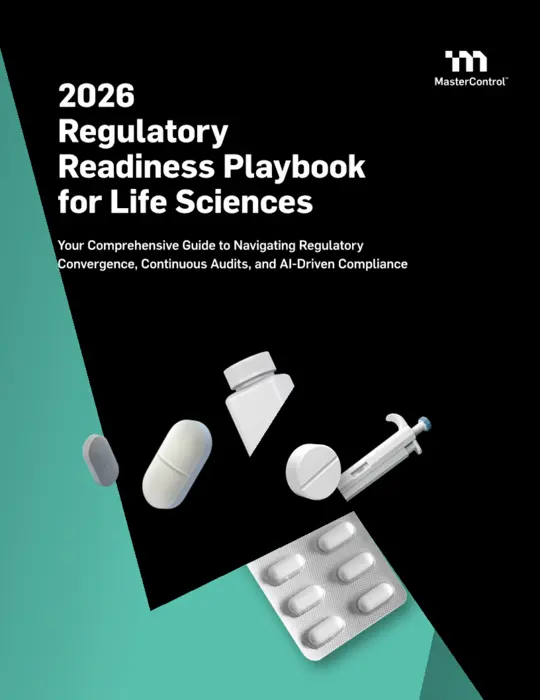
The 2026 Regulatory Readiness Playbook for Life Sciences is a strategic operating guide, not a generic checklist. It's built for quality and manufacturing professionals, operations leaders, and executives who need to move from episodic audits to continuous readiness. Use the Regulatory Readiness Playbook to see how it translates the QMSR's systems-thinking approach into practical, everyday operations.
Here's what's inside the free Regulatory Readiness Playbook:
A clear-eyed breakdown of what's changing across the regulatory landscape and what inspectors look for under new frameworks.
Honest tools and frameworks to assess where your compliance posture actually stands.
A practical model for building continuous readiness into everyday operations.
A globally applicable regulatory readiness blueprint with actionable checklists.
The Regulatory Readiness Playbook operationalizes the QMSR's systems-thinking approach, closing the gap between having procedures and having a functioning quality system. Rather than simply restating what the regulation requires, it gives you a model for making readiness part of how you work every day.
The Playbook doesn't just tell you what the QMSR requires — it gives you the model to make readiness part of how you work.
How to Build a QMSR-Ready Quality System
Building a QMSR-ready quality system means treating readiness as a daily operational discipline. The goal is to make compliance visible in your everyday work, so that an inspection simply confirms what's already happening. The benefits of harmonizing Part 820 and ISO 13485 means it's easier for global companies to have a single source of truth for quality management processes and a connected platform across quality, manufacturing, and asset management gives more insights into areas of risk and the impact across the organization. To evaluate your organization’s ability to unify processes and estimate risks and their impact, consult the 2026 Regulatory Readiness Playbook, which includes assessment frameworks that will help you find gaps before the FDA does.
Action Steps
Run at least one full facility mock inspection per year.
Strengthen risk management documentation by ensuring risk files capture all potential risks, not just the obvious ones.
Review CAPAs as a system, not individual actions, and look for patterns monthly.
Map every process, record, and owner for fast retrieval.
Align all corrective actions to QMSR and ISO 13485 standards, even those from pre-QMSR inspections.
Respond to Form 483s within 15 business days with specific, evidence-based corrective action plans. Although the most recent guidance only makes this expectation applicable to pharma, medical device organizations would be wise to follow the same course of action.
Use the Regulatory Readiness Playbook's assessment frameworks to find gaps before the FDA does.
Common Pitfalls
Unclear ownership of quality processes.
Assessing risk based on individual elements vs. how it impacts the entire quality system.
Inconsistent answers during inspections.
Slow document retrieval.
Weak escalation controls.
Generic Form 483 responses with vague commitments.
QMSR readiness is built in the everyday moments — the mock inspection, the monthly CAPA review, the risk file update — not in the week before the auditor arrives.
Key Takeaways
The QMSR is here, and it's a structural shift: Audits are now ISO 13485-aligned and built on systems thinking.
The first QMSR warning letters target risk management and design controls: Risk management under ISO 13485 Clause 7.1 is the headline finding.
Risk management now drives more than 20% of all 483 observations: It's the top citation category under the new framework.
Continuous audit readiness beats pre-audit scrambling, every time: Readiness is a permanent state, not a sprint.
MasterControl's Regulatory Readiness Playbook is the asset that helps you operationalize it: It’s free to download and enables building regulatory readiness into how you work every day.
What You Should Do Next
Subscribe to the GxP Lifeline newsletter to access other informative articles like this.
Contact us to get answers for your software, quality, and compliance questions.
Sources:
“Quality Management System Regulation (QMSR),” FDA website, content current as of Feb. 2, 2026.
Supra note 1.
“The QMSR is Here: FDA’s First QMSR Warning Letters,” by Allyson B. Mullen and Esther Petrikovsky, The FDA Law Blog, Aug. 12, 2026.
Supra note 3.
Supra note 3.
Supra note 3.
Supra note 1.
Supra note 3.
Supra note 3.

Manufacturing, Quality, and Asset Management — Simplified with Life Sciences-Specialized AI.
MasterControl Inc. is a leading provider of cloud-based quality and manufacturing software for life sciences and other regulated industries. For three decades, our mission has been the same as that of our customers – to bring life-changing products to more people sooner. MasterControl helps organizations digitize, automate, and connect quality and manufacturing processes. Innovative MasterControl tools have a proven track record of improving product quality, reducing cost, and accelerating time to market. Over 1,100 companies worldwide use MasterControl solutions to streamline operations, maintain compliance, easily analyze and interpret large amounts of data, and visualize business insights in real time.
Follow Us
e-book
Enjoying this blog? Learn More.
2026 Regulatory Readiness Playbook for Life Sciences