
What the FDA Wants Life Sciences Companies to Know About Implementing AI
Walk a modern life sciences manufacturing floor today and you'll find artificial intelligence quietly working behind the scenes, triaging deviations, summarizing documents, and flagging quality risks. Regulators are using it too. Yet for many organizations, the policies to govern AI still haven't caught up with the technology already in use. That tension between rapid adoption and responsible oversight is fast becoming one of the defining challenges for quality and manufacturing leaders.
That was the central theme of a recent MasterControl webinar, "Navigating AI Compliance in Life Sciences: FDA Policy Insights for AI Governance," which brought together Danielle Dorfman Faruq, Digital Health and AI/ML Policy Specialist at the U.S. Food and Drug Administration’s (FDA) Digital Health Center of Excellence, and Renee VonBergen, Vice President of Data and AI at MasterControl. The session offered a rare, behind-the-scenes look at how the FDA is thinking about AI governance and what life sciences organizations need to do to keep pace.
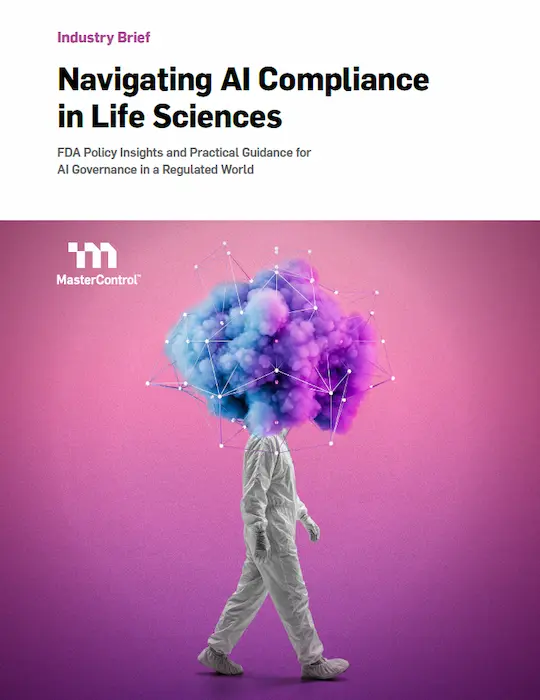
Below is a peek into some of the key insights they shared, plus a look at what they mean for your organization. For the full details, check out the full AI compliance industry brief that provides a deeper examination of FDA policy insights and practical guidance for navigating AI governance in a regulated world.
Where the Life Sciences Industry Stands on AI Adoption
The webinar opened with a snapshot of where life sciences organizations currently sit on the AI maturity curve:
Approximately 77% of quality organizations are in piloting mode, testing one or two AI use cases.
About 20% describe themselves as scaling, expanding pilots that have already shown success.
Roughly 3% remain in the early research and business-case-building phase.
Notably, nobody said they were going to skip AI entirely. AI adoption isn't the question. How to adopt it without compromising regulatory governance is, and that's exactly where compliance risk lives. Life sciences organizations can take the free digital maturity assessment to see which group they relate to best when it comes to AI-readiness.
Download the "Navigating AI Compliance in Life Sciences" industry brief to see the full breakdown of where quality organizations stand on AI adoption and what it means for your strategy.
The FDA's 5 Themes for AI Governance
Dorfman Faruq walked through the FDA's perspective on AI in regulated environments, anchored by five key themes the agency sees as essential:
Data and quality management. AI models are only as good as the data they're trained on. The FDA emphasizes fit-for-purpose, representative data, which matters not just for developers building models but for organizations acquiring AI tools.
Human oversight. Of the more than 1,000 AI-enabled medical devices the FDA has cleared or approved, none is fully autonomous. A human is always in the loop.
Transparency. Users need clear, essential information at the most appropriate time to interpret AI outputs correctly.
Monitoring. AI systems require continuous performance assessment, not a one-time validation event. Model drift is real, and systems that perform well initially can degrade over time.
Governance. Frameworks, processes, and standards should span the entire lifecycle of an AI application and extend to the organizational level.
These themes draw on international work, including the IMDRF's Technical Framework for Artificial Intelligence Lifecycle Management and the finalized Good Machine Learning Practice for Medical Device Development guidance.
Want the full breakdown of the FDA's five governance themes and what each one means for your organization? Download the industry brief.
A Cautionary Tale From an FDA Warning Letter
One of the most compelling moments of the webinar was the discussion of a recent FDA Warning Letter involving the inappropriate use of AI in pharmaceutical manufacturing. In that case, a manufacturer used an AI agent to determine which regulations applied to their facility. The AI agent failed to surface a specific legal requirement. No human caught the gap. The manufacturer fell out of compliance and received a Warning Letter.
The takeaway? The FDA expects review and clearance by an authorized human representative whenever AI outputs are consumed as a basis for compliance decisions. AI that isn't overseen by someone qualified to evaluate its outputs isn't just ineffective. It's a liability.
The brief dives deeper into this case and explores the critical distinction between having a human "in the loop" and having the right human in the loop.
Building a Defensible Foundation with ISO 42001
If you're looking for a recognized standard to anchor your AI governance efforts, the webinar pointed to one clear answer: ISO 42001. Released in 2023, it's the first international standard for managing AI as a system. Think of it the way ISO 9001 applies to quality systems: a complete, auditable, internationally recognized package covering governance, risk, lifecycle controls, transparency, and continual improvement.
Practical Steps for Compliant AI Adoption
In the webinar, FDA representatives discussed and outlined several practical steps organizations can take to build compliant AI practices:
Stand up a cross-functional AI governance committee. Quality can't own AI governance alone. AI touches data, security, legal, privacy, compliance, manufacturing, and software lifecycle management simultaneously.
Start with low-risk use cases. Begin with assistive applications where the human is unambiguously in control, such as document search, training exam generation, summarization, and deviation triage.
Define intended use before deployment. Document what the tool does, what data it uses, what human verification looks like, and what it should not be used for.
Vet AI vendors like regulated suppliers. Don't rely on demos or marketing materials. Ask for governance evidence.
This free on-demand webinar also explores the important distinction between vendor responsibility and organizational responsibility when it comes to compliant AI, and why neither side can carry the burden alone.
Key FDA Takeaways on Adopting AI in Life Sciences
Here's a quick summary of the most important points from the webinar and industry brief:
AI adoption is widespread, but governance often lags behind deployment.
The FDA's five themes (data, human oversight, transparency, monitoring, and governance) provide a practical framework for thinking about compliant AI.
The case of the recent AI-related FDA Warning Letter underscores the necessity of meaningful human oversight, not just nominal human presence.
ISO 42001 offers a defensible, internationally recognized foundation for AI governance.
Starting with low-risk, assistive use cases builds organizational confidence and compliance muscle before higher-stakes applications are introduced.
AI compliance is an outcome of how well your quality and manufacturing systems are connected, governed, and designed to keep humans meaningfully in control.
You can watch the full webinar video for free and get access to this entire discussion around compliant AI adoption directly from the FDA themselves. Ready to go deeper? Download the "Navigating AI Compliance in Life Sciences" industry brief for the full FDA policy insights, the complete Warning Letter analysis, a practical roadmap for compliant AI adoption, and a closer look at MasterControl's ISO 42001-certified approach to building AI into the foundation of its connected platform.
Get the full details by downloading the "Navigating AI Compliance in Life Sciences" industry brief.
What You Should Do Next
Subscribe to the GxP Lifeline newsletter to access other informative articles like this.
Contact us to get answers for your software, quality, and compliance questions.

Manufacturing, Quality, and Asset Management — Simplified with Life Sciences-Specialized AI.
MasterControl Inc. is a leading provider of cloud-based quality and manufacturing software for life sciences and other regulated industries. For three decades, our mission has been the same as that of our customers – to bring life-changing products to more people sooner. MasterControl helps organizations digitize, automate, and connect quality and manufacturing processes. Innovative MasterControl tools have a proven track record of improving product quality, reducing cost, and accelerating time to market. Over 1,100 companies worldwide use MasterControl solutions to streamline operations, maintain compliance, easily analyze and interpret large amounts of data, and visualize business insights in real time.
Follow Us
Industry Brief
Enjoying this blog? Learn More.
Navigating AI Compliance in Life Sciences